
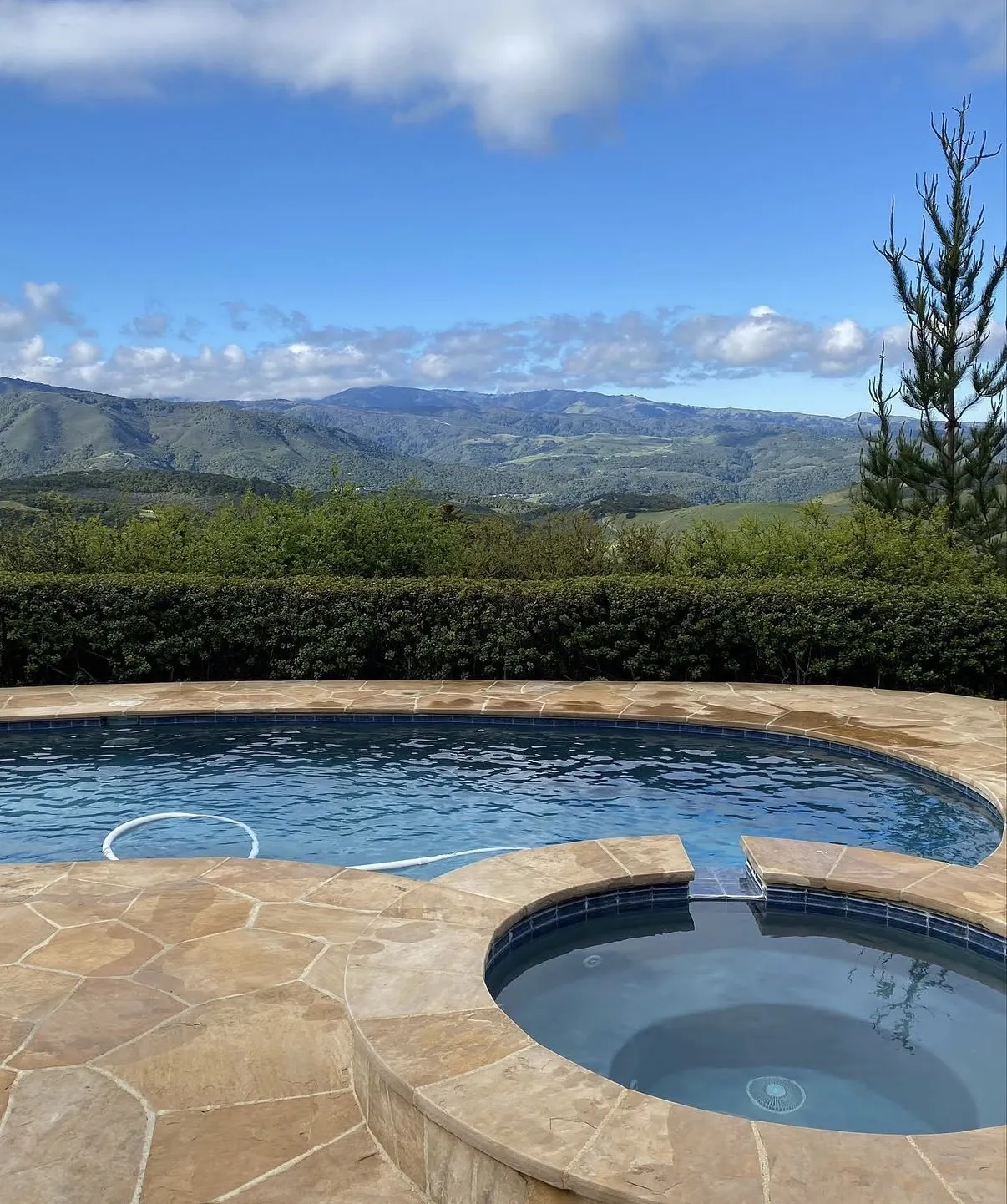
Pool design
Pool Design That Starts With Your Yard
The best pool for your property is largely already determined by the property. Design is the work of finding it — reading the site, the house and the way you live outdoors, then resolving the conflicts between them.
- CSLB #1079748 · C-53 Swimming Pool
- Based in Salinas, working the Monterey Bay
- Monday to Saturday, 8am to 5pm
Design is subtraction before it is addition
Homeowners usually arrive with a folder of images. That is a useful starting point and a misleading one, because the images are of other people’s sites.
A pool photographed in a flat Arizona backyard at midday does not translate to a north-facing Carmel lot where the sun leaves the yard at four and the wind arrives at three. The shape reads the same in a photograph and behaves completely differently in use. So the first job is not to pick a shape. It is to find out what your particular piece of ground will and will not support.
That means walking the site at the hour you would actually use it. Where does the afternoon sun land. Where does the wind come from and what breaks it. Where do you look from the kitchen window, and what do you want to be looking at. Where does water go when it rains hard. How do you get from the back door to the water without crossing something hot, wet or awkward.
Once those are answered, the pool nearly draws itself, and the conversation moves to the interesting part: what the water should do, what it should be made of, and how the yard reads as one composition rather than a pool with things around it.
What we work through with you
A design conversation that skips any of these tends to produce a pool that photographs well and disappoints in August.
- How you will use itLap swimming, small children, entertaining and quiet soaking produce four different pools. Most families want a blend, and the blend has to be prioritised or nothing is done well.
- The houseA pool takes its geometry, materials and colour palette from the architecture behind it. A rectilinear modern house and a rambling ranch want different answers, and copying the house too literally is as wrong as ignoring it.
- SightlinesWhat the pool looks like from inside the house matters more than what it looks like from the far corner of the lawn, because that is the view you get every day of the year including the ones you do not swim.
- Sun and shadeWater heats from the sun far more than most people expect. A pool in shade from two o’clock has a materially different heating bill from the same pool eight feet to the west.
- WindEvaporation is the largest single heat loss from an open pool, and wind drives evaporation. On the coast this is the difference between a pool you use and a pool you look at.
- Deck before poolPeople spend more hours on the deck than in the water. Deck size, circulation, where the table goes and where the sun loungers face deserve to be designed rather than left over.
- EquipmentThe pad has to go somewhere, be reachable for service, be screened, and not be audible from a bedroom window. Deciding this during design is free; deciding it after the deck is poured is not.
- The long viewEvery design choice has a maintenance consequence. Deciduous trees overhanging water, unlit dark corners, an infinity edge that needs a basin — all legitimate, all worth choosing knowingly.
Shape, and why rectangles keep winning
Freeform pools were the default for thirty years, and they still suit sites with irregular geometry, mature planting or naturalistic hardscape. But a rectangle does several things well that a kidney cannot. It gives you a usable swimming length. It matches rectilinear architecture. It accepts an automatic safety cover, which is the single most useful piece of equipment on a family pool. And it wastes less of a small lot, because every square foot of a rectangle is swimmable.
The interesting middle ground is a geometric pool with one moment of softness — a radiused corner, a curved bench, a spa that breaks the line. That reads as designed rather than defaulted, which is the whole point.
On small lots the decision is usually made for you. Once setbacks and the deck you actually need are subtracted, what is left is often a long, narrow rectangle, and the design work becomes making that rectangle feel generous rather than apologetic — with depth transitions, a bench the full length of one side, and a finish colour that makes the water look deeper than it is.
Colour: the water is clear
Pool water has no colour. What you see is the interior finish, modified by depth, by the sky and by whatever is reflected off the surface. A white plaster pool under Monterey overcast reads pale grey-green; the same pool in Hollister under a hard blue July sky reads bright turquoise. Same pool.
That is why finish samples have to be looked at wet, outdoors, at your site, at the time of day you care about — and why a dark finish, which people choose for drama, behaves differently here than in photographs taken elsewhere. Dark finishes absorb more solar gain, which is genuinely useful on a fog-belt property. They also show surface deposits sooner and make the bottom harder to see, which matters with small children.
Tile is where a design earns its keep. The waterline band is the one element seen from every angle, wet and dry, lit and unlit, and it is a small enough quantity that good tile is affordable in a way good stone often is not.
Features worth designing in, not bolting on
Each of these is easier and cheaper to build during the shell phase than to retrofit afterwards. Some cannot be retrofitted at all.
- Pool and spa combinationsShared equipment, spillover, year-round use
- Infinity and vanishing edgesTurning a fall in the ground into the view
- Baja shelves and tanning ledgesShallow water for lounging and small children
- Water featuresSpillways, sheer descents and scuppers
- Equipment and automationHeating, sanitising and controlling it from a phone
- Small backyard pool ideasGetting a real pool out of a tight lot
Design questions
Do you charge for design?
The first conversation and the estimate are free. We will walk the site, talk through what is realistic and give you a number. Design and engineering work that produces a permit-ready plan set is part of the project, and we will be clear about what is included before you commit to anything.
Can I bring my own designer or landscape architect?
Yes, and it often produces the best result on a larger property. We build to a designer’s drawings routinely, and we will flag anything in a set that will not work hydraulically, structurally or under the local code before it becomes a problem on site.
What size pool do I need?
For general family use, most people are well served by something in the range of a small rectangle you can cross in a few strokes up to a full lap length, and the constraint is almost always the lot rather than the budget. If lap swimming matters, that sets the length and everything else follows. If it does not, a smaller pool with a bigger deck is usually the happier yard.
Should the spa be attached to the pool or separate?
Attached is more common because it shares equipment, plumbing and structure, and it gives you a spillover that keeps the pool surface moving. Separate is quieter, can go where the view is, and lets you run the spa hot in winter without heating anything else — but it is a second structure, and it costs like one.
How do I keep the equipment from being noisy?
Distance, screening and a variable-speed pump. Variable-speed pumps are required on new residential pool installations in California and are far quieter than the single-speed pumps people remember, because most of the time they run slowly. Where the pad sits relative to bedrooms and to your neighbour’s bedrooms is a design decision we make deliberately.
Free estimate
Tell us about the yard
Send a few photos and roughly what you have in mind, and we will tell you what is realistic on your site. Estimates are free and there is no obligation.