
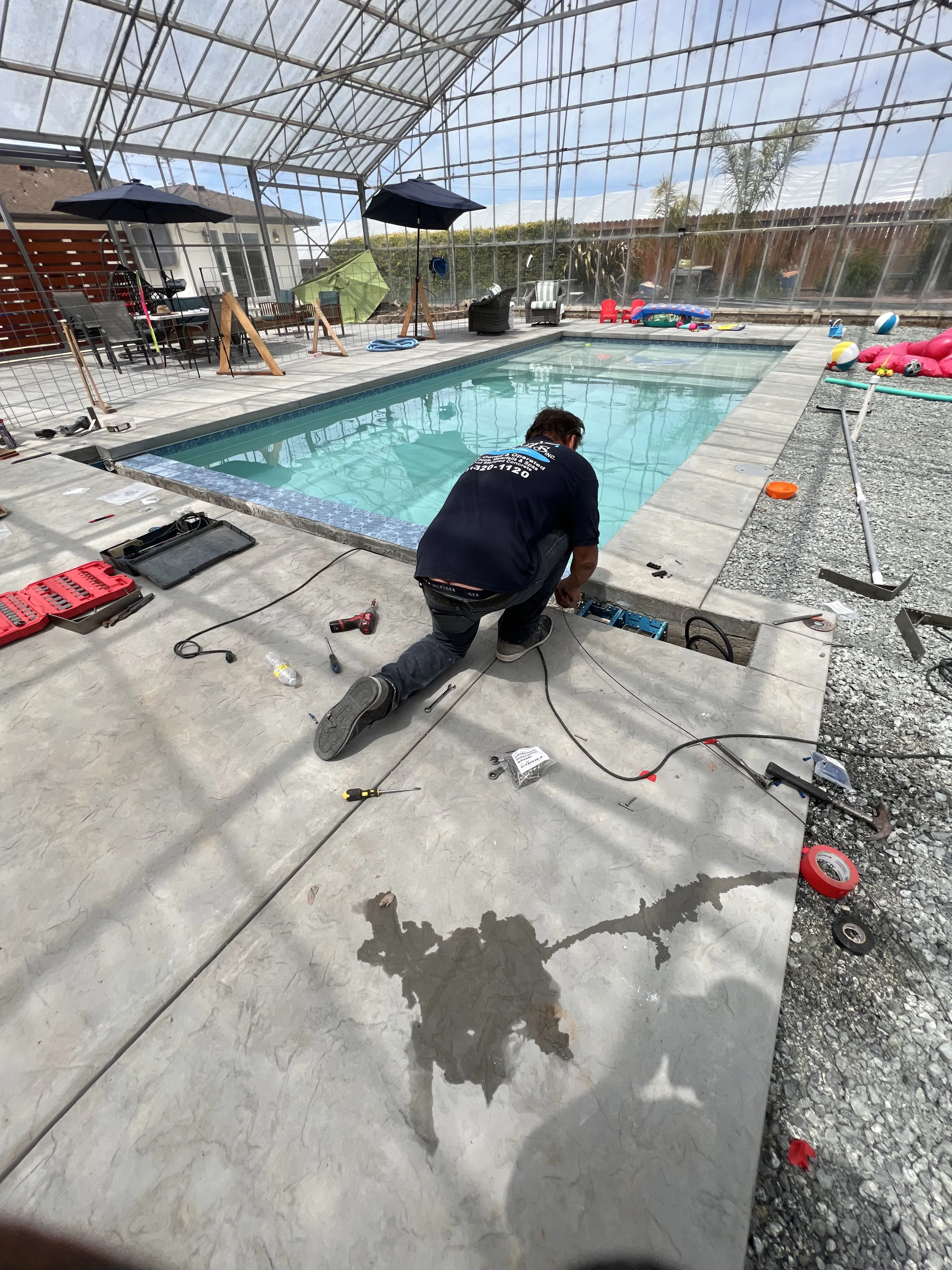
Repair & service
Pool Repair and Equipment Service
Most pool problems are one failed component wearing a disguise. The work is finding which one, before anybody sells you a replacement for something that was never broken.
- CSLB #1079748 · C-53 Swimming Pool
- Based in Salinas, working the Monterey Bay
- Monday to Saturday, 8am to 5pm
Diagnosis first
A pool is a closed hydraulic and electrical system, which means a fault in one place shows up as a symptom somewhere else entirely.
A heater that will not fire is often a flow problem, not a heater problem. Air in the return lines is usually a suction-side leak upstream of the pump rather than anything wrong with the pump. A pool that keeps losing water may have a leak, or may simply be sitting in a windy spot in August. Cloudy water that will not clear can be a filter at the end of its life, a pump running too few hours, or chemistry that has quietly drifted out of range.
Because of that, we diagnose before we quote. It is slower, it occasionally means telling you the thing you were ready to buy is not what you need, and it is the only honest way to do this work. A shop that sells you a heater over the phone has not seen your flow rate.
Building and servicing the same systems helps here. When you have plumbed a pad from scratch, you know what the pipe behind the wall probably looks like, and you know which failure modes are common on which equipment.
What we repair
- Pumps and motorsNoisy bearings, failed seals, motors that trip, and single-speed pumps due for a variable-speed replacement.
- FiltersCartridge, DE and sand: leaking manifolds, cracked laterals, blown tank bands, and filters simply undersized for the pool.
- HeatersIgnition faults, flow faults, corroded heat exchangers, gas supply issues and control boards. Heaters throw error codes for reasons that are frequently outside the heater.
- LeaksFinding them first: pressure-testing lines, isolating the shell from the plumbing, and checking skimmers, returns, lights and the spa dam wall before anything is dug.
- Valves and plumbingSeized diverters, failed actuators, leaking unions and the slow, undramatic pinhole leaks in old pad plumbing.
- Automation and controlsControllers that have lost their schedules, dead relays, failed sensors, and older systems that can be updated rather than replaced.
- SanitisingSalt cells at the end of their life, failed chlorinators, and systems that were never sized for the pool in the first place.
- LightingDead niches, water intrusion, and conversions from incandescent to LED.
- Automatic coversTracks, ropes, motors and lids. Covers are mechanical systems that live outdoors, and they need service.
- Spa equipmentBlowers, jets, heaters and controls on integrated spas and standalone spa equipment.
When the pool is losing water
Every open pool loses water to evaporation, and how much depends on wind, humidity, sun and water temperature. On a breezy coastal afternoon a pool can lose a surprising amount without anything being wrong, which is why the first question is always how much, over how long, compared with what is normal for that site at that time of year.
A simple bucket test separates evaporation from a leak: float a bucket of pool water on a step, mark the level inside and outside, and come back in a day or two. If the pool has dropped further than the bucket, water is leaving through something other than the air.
From there it is a matter of narrowing down: the shell, the skimmer throat, a return fitting, a light niche, the spa dam, or the buried plumbing. Each is tested differently, and each has a completely different repair. The mistake to avoid is opening concrete before the location is confirmed.
Repair or replace
Some repairs are obviously worth it — a seal, a gasket, an actuator, a control board. Some are obviously not: a motor at the end of its life on a pump that is a generation behind, where the replacement is quieter, uses far less electricity and comes with a warranty.
The line moved when California required variable-speed pumps on residential pool installations. If your single-speed pump has a significant fault, replacing it is usually the right call rather than the upsell, because the running cost difference is real and continuous.
On heaters the calculation is different. Heaters are expensive, and a well-maintained one repaired properly can run for a long time. We will give you the honest comparison — cost of the repair, realistic remaining life, and what the replacement would actually cost to run — and let you decide.
Repair questions
Do you work on pools you did not build?
Yes, and most of our repair work is on pools built by someone else. It helps to know roughly how old the pool is and whether anything has been replaced recently.
My heater shows an error code. Is the heater dead?
Often not. Modern heaters shut down and report a fault when something upstream is wrong — insufficient flow, a dirty filter, a closed valve, low gas pressure, a failed sensor. The code is a starting point for diagnosis, not a diagnosis.
How do I know if I have a leak or it is just evaporation?
Do the bucket test. Float a bucket of pool water on a step, mark the water level inside and outside the bucket, run the pool normally, and compare after a day or two. If the pool level drops more than the bucket level, you have a leak worth investigating.
Can you replace just the pump motor instead of the whole pump?
Sometimes, and it can be good value on a newer pump. On an older single-speed unit the replacement pump is usually the better buy, because variable-speed is now the standard on new residential installations and the running-cost difference is substantial.
Do you repair automatic pool covers?
Yes. Tracks, ropes, motors, lids and the fabric itself. Covers are one of the most useful things on a pool — for safety, for heat retention and for keeping water in — and they are worth keeping in service rather than abandoning.
Do you offer emergency call-outs?
Call us and tell us what is happening. Some faults genuinely need attention the same day — a pump that has lost prime and is running dry, water pouring out of a failed union, a cover stuck open. Others are safe to schedule.
Free estimate
Tell us about the yard
Send a few photos and roughly what you have in mind, and we will tell you what is realistic on your site. Estimates are free and there is no obligation.