
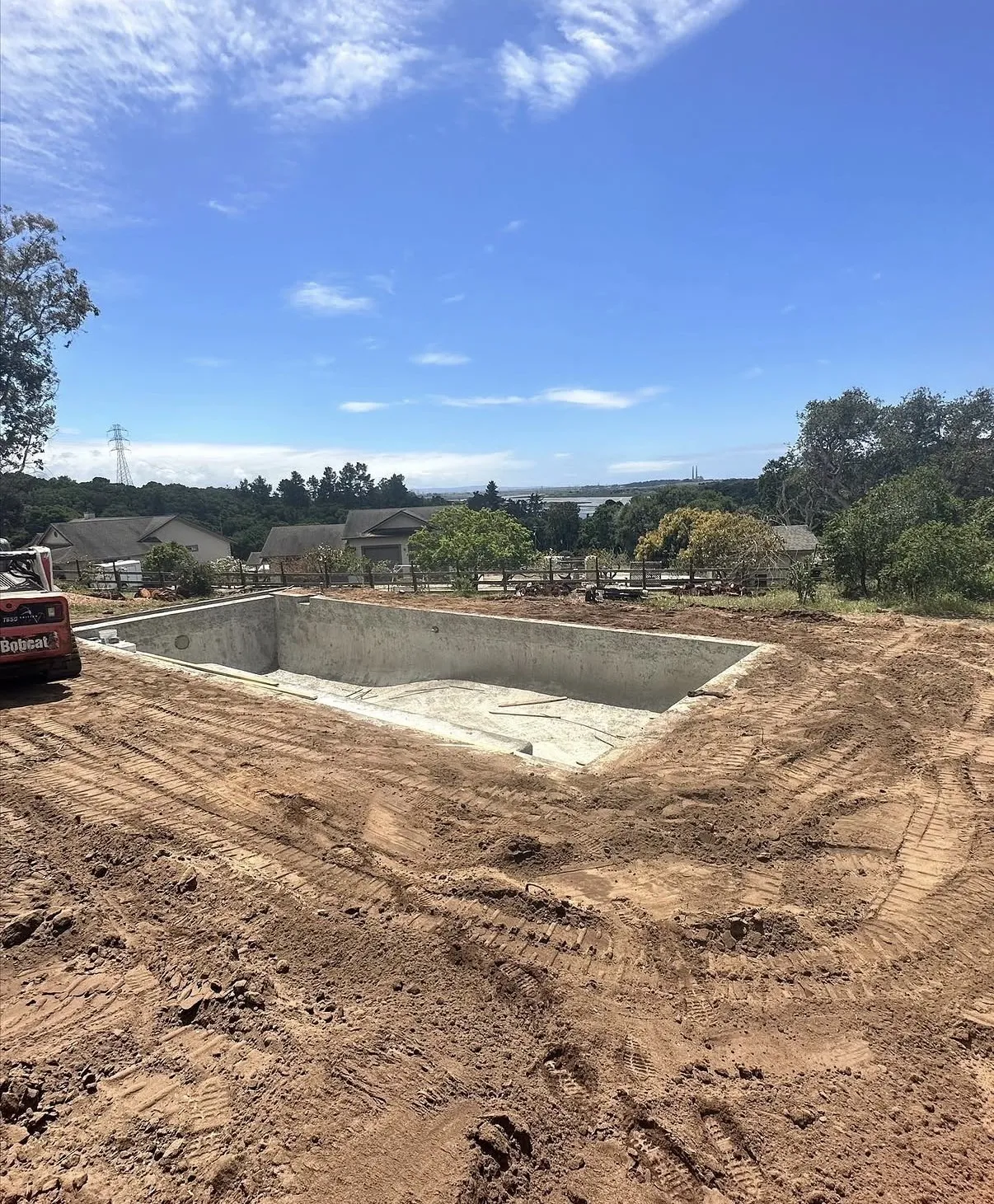
Pool construction
Custom Pool Construction on the Monterey Bay
A pool is a structural concrete tank, a buried plumbing system and a small water-treatment plant, built in a yard that has to be put back together afterwards. Here is how we build one, in the order it happens, and what decides each call along the way.
- CSLB #1079748 · C-53 Swimming Pool
- Based in Salinas, working the Monterey Bay
- Monday to Saturday, 8am to 5pm
What you are actually buying
Most pool pages describe a finished pool. The part that determines whether you are happy in ten years happens before anything is visible.
A concrete pool is one structure doing four jobs at once. It holds tens of thousands of gallons against soil that moves. It carries water to and from the equipment fast enough to turn the whole volume over every few hours, quietly. It presents a waterproof, comfortable surface to bare feet. And it sits inside a yard that still has to drain, be walked through and be maintained.
Those four jobs pull in different directions, and every meaningful decision in a pool build is a trade between them. A deeper pool is better for diving and worse for heating. A longer run to the equipment pad is quieter at the house and harder on the pump. A wider tanning ledge is lovely and takes usable swimming area out of a small yard. There is no single right answer, which is why a real design conversation beats a catalogue.
Supreme Pools builds under California licence 1079748, classification C-53, the state classification specific to swimming pools and spas. One contractor handles the excavation, the shell, the plumbing, the deck, the finish and the startup, then comes back to service the water. That matters less for pride of workmanship than for accountability: when the same crew that set the plumbing is the crew that starts the equipment, nothing falls through a gap between trades.
What a build includes
One contract, one licence, one crew accountable for all of it.
- Custom gunite pool constructionA new in-ground concrete pool designed and built from bare ground — layout, excavation, steel, plumbing, shell, finishes and startup.
- Pool and spa constructionThe spa built into the same shell and the same hydraulic system as the pool, rather than bolted on afterwards.
- Pool decking and hardscapeThe deck poured or set as part of the same job, which is also where the yard’s drainage gets solved.
- Water features built into the shellSpillways, sheer descents and scuppers plumbed during rough-in, while the trench is still open.
The build, in the order it happens
Each phase has to cure, pass inspection or simply be finished before the next one can start, which is why a pool cannot be compressed past a certain point no matter how much crew is on site.
Design, engineering and permits
We walk the site, take levels, find the utilities and work out how a machine gets into the yard at all. That becomes a plan set: shape and depths, structural detail for the shell, an equipment schedule and a plumbing diagram. The plan set goes to your city or county building department for a permit. Nothing is dug before the permit is issued.
Access is the single most underestimated constraint on the Central Coast. A yard reachable only through a four-foot side gate is a different job, and a different price, from one a machine can drive into.
Layout and excavation
The pool is marked out on the ground in paint so you can stand in it before it exists. This is the last cheap moment to move it a foot. Then the hole is dug to the shape of the finished shell plus the thickness of the concrete, and the spoil is hauled off or placed on site.
Standing in the painted outline is worth the trip home from work. Plans read differently from a lawn.
Steel and plumbing rough-in
Reinforcing steel is tied into a cage that follows the shape of the shell, held off the soil so concrete surrounds it completely. At the same time the plumbing is run: suction lines, returns, the spa loop, any water feature, and the conduits for lights and bonding. The plumbing is pressure-tested and left under pressure so a leak shows up now rather than under a concrete deck.
Gunite or shotcrete shell
Concrete is pneumatically applied over the steel to form a monolithic shell, then carved and screeded to the finished profile — steps, benches, the spa dam wall, the tanning ledge. It is a one-day, continuous operation, and it is the day the pool stops being a hole.
The shell is then water-cured for several days. Curing is not waiting around; it is the process that gets the concrete to strength, and rushing it is a decision you pay for later.
Tile, coping and masonry
Waterline tile is set, then the coping — the cap where the deck meets the water. Coping decides how the pool looks from every angle and how it feels under your hands when you rest at the edge, so it is worth spending real time on the sample board.
Decking
Forms go in, the sub-base is compacted, and the deck is poured and finished: broom, stamped, exposed aggregate, or set as pavers or flagstone over a base. Decking is where drainage gets solved, so the yard sheds water away from the house and the pool rather than into them.
Equipment set and electrical
The pad is built, the pump, filter, heater, sanitiser and automation are set and plumbed, and the electrical is run, bonded and inspected. Equipotential bonding — tying all the metal in and around the pool into one electrical plane — is a code requirement and a safety one, and it is inspected before anything is buried.
Interior finish
The shell is prepared and the interior finish is applied: plaster, a pebble aggregate, or a quartz blend. This is the surface you feel and the colour you see, because the water itself is clear; the blue comes from the finish and the sky.
Fill, startup and handover
The pool is filled in one continuous fill, and startup begins immediately — brushing, balancing and staged chemistry over the first weeks while a new finish cures underwater. We walk you through the equipment, the automation and what the pool needs week to week, and hand over the paperwork.
Startup is not a formality. What happens in the first thirty days sets how a plaster finish looks for the next fifteen years.
Why the shell is sprayed, not poured
A pool shell is a curved, variable-thickness structure with no flat faces to speak of. Building forms for that and pouring wet concrete into them would be slow, expensive and, on the floor of the pool, impossible. Instead the concrete is delivered through a hose at high velocity and builds up against the steel, taking any shape the crew carves.
The two methods people name — gunite and shotcrete — describe when the water is added. Gunite arrives dry and is wetted at the nozzle; shotcrete arrives as ready-mixed wet concrete and is pumped. Both produce a monolithic shell, and both are used routinely on residential pools in California. The practical differences are about scheduling, mix control and site conditions rather than one being categorically stronger than the other, and any builder who tells you otherwise is selling the method they happen to own.
We go into the trade-off properly in gunite vs. shotcrete, including which one we reach for and why.
The part nobody shows you: hydraulics
Every gallon in your pool should pass through the filter regularly, and the pump has to move it there and back through buried pipe. How hard the pump works depends almost entirely on decisions made during rough-in: pipe diameter, the number of fittings, how many sweeping bends versus sharp elbows, and how far the pad sits from the water.
Undersized plumbing is invisible on handover day and expensive forever. It shows up as a pump that runs louder and longer to achieve the same turnover, a heater that short-cycles, and an electricity bill nobody can explain. Oversized pipe with generous radii costs a few hundred dollars more in materials during a phase where the trench is already open, and it pays that back every month the pool exists.
This is also where equipment placement is decided. Pads tucked close to the house are cheap to plumb and audible from the kitchen window. Pads set behind a garage are quieter and need larger pipe to compensate for the run. Neither is wrong; the point is that it is a choice, and it should be made deliberately rather than by whoever is holding the shovel.
What the site decides before you decide anything
By the time we have walked a yard, most of the pool has already been suggested by the ground. These are the constraints that do the deciding.
- AccessWhether excavation equipment can reach the yard, and what has to come out — a fence, a section of wall, a tree — to let it. Hand-dig and conveyor work is possible and changes the budget.
- GradeA flat yard takes a flush pool. A slope takes retaining, a raised bond beam, or a vanishing edge that turns the fall into the feature.
- SoilSand, clay and fill all behave differently against a concrete shell, and expansive soils in particular drive structural detailing. Where conditions warrant it, a soils report tells the engineer what to design for.
- GroundwaterA high water table means a hydrostatic relief valve and a plan for keeping the hole dry long enough to shoot the shell. It is a real factor in low-lying ground near the bay and in the Pajaro Valley.
- SetbacksYour city or county sets how close water and equipment may sit to a property line. Those numbers, not taste, usually fix the pool’s footprint in a compact lot.
- UtilitiesSewer laterals, gas, water services and leach fields all have to be located before a bucket touches the ground, and any one of them can move a pool.
- Sun and windWhere the sun lands in the afternoon decides where you will actually sit. On the coast, the afternoon breeze decides how much heat you lose and where a windbreak earns its keep.
- TreesMature trees mean roots in the excavation and leaves in the water, and in several local jurisdictions they also mean a separate tree permit before anything is removed.
Finishes, and how long each one lasts
The interior finish is the only part of the structure you touch. White marble plaster is the traditional choice and the least expensive: smooth, bright, and the shortest-lived of the options, because it is a thin cementitious coat that slowly gives up its surface to water chemistry. Quartz-blended finishes add hardness and colour stability. Pebble finishes bind natural aggregate into the matrix, giving a tougher, more forgiving surface with visible texture underfoot.
None of them are permanent. Every plastered pool is on a resurfacing clock, and how fast that clock runs is decided less by the product than by water chemistry — which is the honest argument for a maintenance routine that does not drift. A pool held in balance outlasts an identical pool that is not, by years.
When the clock runs out, the work is a resurfacing, not a rebuild: the shell you are standing in is the same shell.
Questions homeowners actually ask
Do I need a permit to build a swimming pool in California?
Yes. A residential in-ground pool is a permitted structure everywhere in our service area, and the permit covers the structure, the electrical and the plumbing. Depending on the jurisdiction and the property, planning or zoning clearance, a coastal development permit, a tree permit or a geologic review may be required before the building permit is issued. We handle the submittal and the inspections.
What safety features does the law require on a new pool?
California’s Swimming Pool Safety Act requires at least two of seven listed drowning-prevention features when a building permit is issued for a new pool or spa at a private single-family home. The seven include an isolation enclosure, removable mesh fencing, an approved safety cover, exit alarms on doors with direct pool access, a self-closing self-latching door device, a pool alarm, and other independently verified protection. Some pairings are specifically excluded, so two devices on the same door do not count as two features. Which combination suits your property is worth settling early, because a fence line changes the deck layout, and the building official inspects the features before signing off the permit.
Can you build a pool on a sloped lot?
Routinely. A slope is handled with retaining, a raised bond beam, engineered fill, or by designing the fall into the pool as a raised spa or a vanishing edge. What it always adds is engineering and structural concrete, so a hillside pool costs more than the same pool on flat ground. The compensation is usually the view.
How deep should the pool be?
Deeper than about five feet buys you very little unless you are diving, and it costs you heating, chemicals and swimming area. Most families are better served by a long shallow end they can stand and play in, a defined deep end around five to six feet, and the money saved spent on the deck and the finish. Diving boards have specific depth and shape requirements and are a deliberate design decision, not an add-on.
What happens to all the dirt?
It is hauled off, unless there is somewhere on your property it can usefully go — building up a low corner, forming a berm or backfilling a slope. Spoil haul-off is a real line item and worth discussing early, because a site with somewhere to put the dirt is a cheaper site.
Will my yard be destroyed?
Parts of it, temporarily and honestly. Excavation equipment has to reach the hole, spoil has to be stockpiled, and the shell crew needs room to work. We agree the access route before we start so you know which fence, lawn or planting bed is in the path, and we put the ground back as part of the job.
Do you build fibreglass or vinyl-liner pools?
No. We build concrete pools — gunite and shotcrete shells with tile, coping and a plaster, quartz or pebble interior. That is what the C-53 work on the Central Coast is, and it is what lets a pool take any shape, any depth and any site.
Where these facts come from
Regulatory claims on this page are taken from the primary sources below rather than from industry summaries. We re-check them on a schedule; the date is when each was last confirmed.
- California Health and Safety Code § 115922Checked September 12, 2026
- California Health and Safety Code § 115924Checked September 12, 2026
- CSLB licence classification C-53Checked September 12, 2026
Where to go next
- How we build, stage by stageThe same sequence with what happens on each visit
- Pool designWorking out the shape before the shovel
- Features and optionsSpas, ledges, edges and water
- What drives the budgetThe line items that actually move the number
- Pool builder in MontereyLocal conditions, permits and water
- Pool builder in SalinasValley heat, valley soils, city permits
Free estimate
Tell us about the yard
Send a few photos and roughly what you have in mind, and we will tell you what is realistic on your site. Estimates are free and there is no obligation.