
Equipment
Pool Equipment and Automation
The equipment pad is where a pool costs money every month for the rest of its life. Getting it right is mostly a question of sizing, and mostly ignored.
- CSLB #1079748 · C-53 Swimming Pool
- Based in Salinas, working the Monterey Bay
- Monday to Saturday, 8am to 5pm
Sizing beats brand
People ask which brand of pump to buy. It is close to the least important question on the pad.
All the major manufacturers make good equipment. What separates a pad that runs quietly and cheaply from one that does not is whether each component is matched to the pool and to the plumbing it is connected to: a pump sized to the pipe rather than to the horsepower on the box, a filter with enough area that it is not permanently near its service point, a heater matched to the volume and to how fast you actually want it warm.
Oversizing is as much a fault as undersizing. An oversized pump in undersized pipe cannot deliver its rated flow and simply burns power trying. An oversized heater short-cycles. An undersized filter needs cleaning constantly and never quite clears the water.
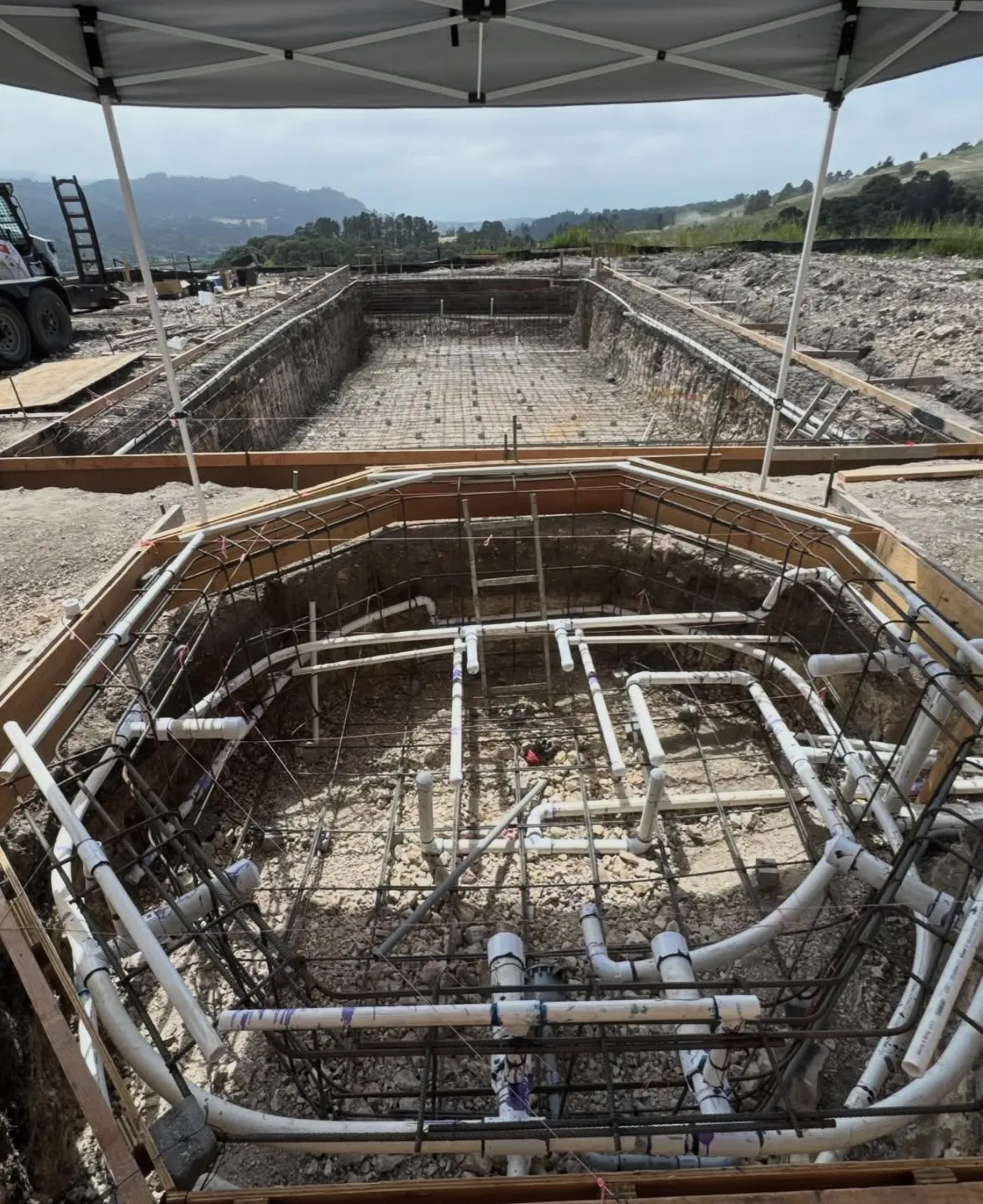
This is also why the plumbing decisions made during construction or during a remodel matter more than the equipment catalogue. Pipe is the constraint, and pipe is buried.
What goes on a modern pad
- Variable-speed pumpThe state’s efficiency rules have ruled out single-speed pool pump motors since 2010, and it is the single biggest running-cost item on the pad. Long slow filtration is quieter, filters better and costs a fraction of short fast filtration.
- FilterCartridge, DE or sand. Cartridge is the common choice: no backwashing and therefore no water wasted, at the cost of periodic cleaning by hand.
- HeaterGas for speed, heat pump for efficiency, solar where the roof and the orientation suit it. On the coast this is not optional equipment — it is what makes the pool usable.
- SanitisingSalt chlorine generation, a chlorinator, or a supplementary system. All of them produce a chlorinated pool; they differ in how the chlorine gets there and how the water feels.
- AutomationScheduling, valve actuators, heater control, lighting scenes and remote access. The practical benefit is that the pool runs on a correct schedule instead of whatever was set at handover.
- LED lightingColour-changing, far lower power draw and a service life measured in years rather than seasons.
- Bonding and GFCINot an option. Every metal component in and around the pool is tied into one electrical plane and inspected, and pool circuits are ground-fault protected.
- CoversAutomatic safety covers do three jobs at once — safety, heat retention and keeping debris out — which makes them the best-value item on the list.
Heating, honestly
A pool loses most of its heat from the surface, and most of that to evaporation rather than to the air. Which means the two things that govern your heating bill are how much surface you expose and how much wind crosses it — not the efficiency rating of the heater.
That has a specific consequence around here. A pool on the Peninsula or the Santa Cruz coast, under a marine layer with a steady afternoon onshore breeze, loses heat far faster than the same pool in Hollister, Gilroy or the Salinas Valley. Inland, a pool warms itself for a good part of the year. On the fog belt, it does not, and a pool without a heater and a cover there is a decorative feature.
Gas heaters raise temperature fast, which suits a spa and suits a pool you heat for a weekend. Heat pumps move heat rather than making it and are far cheaper to run, but they work slowly and lose capacity as the air cools — which is precisely when a coastal pool needs them. Solar is genuinely cheap to run when the roof area and orientation are there. Most well-specified coastal pools end up with a cover plus one active heat source, and the cover doing more work than anyone expects.
There is more on this in heating a pool on the coast.
Salt air and the equipment pad
Equipment near the ocean corrodes faster. Heater cabinets, fasteners, control enclosures, light rings and handrail anchors all live in a salt-laden atmosphere, and over a decade the difference between a sheltered pad and one facing straight into onshore wind is visible and expensive.
The fixes are unglamorous: put the pad where it is not taking direct onshore weather, give it a roof or a screen that still allows the airflow a heater needs, choose corrosion-resistant hardware, and rinse things occasionally. None of it is difficult. All of it is easier to do when the pad is being built than when it is being replaced.
Equipment questions
Do I have to have a variable-speed pump?
Effectively, yes. California’s appliance efficiency regulations have required residential pool pump motors to be multi-speed or variable-speed rather than single-speed since 2010, and further rules cover replacement pool pump motors sold in the state. It is also what you would choose anyway: the running-cost difference against an old single-speed pump is substantial and continuous.
Gas heater or heat pump?
Gas if you want the pool or spa hot quickly and use it in bursts. Heat pump if you want to hold a temperature over a season and care about running cost. On the coast, where the air is cool exactly when you want heat, a gas heater plus a cover is often the more practical combination — but it depends on how you actually use the pool.
Is a salt pool chlorine-free?
No, and this is the most persistent myth in the industry. A salt system makes chlorine from salt in the water. The pool is chlorinated; the chlorine is simply generated on site at a steady rate rather than added by hand. The water does feel softer, and most people prefer it.
How long does pool equipment last?
It varies enormously with exposure, run hours and water chemistry, and near the ocean everything metal has a harder life. Rather than working to a number, watch for the signals: rising noise from a pump, climbing filter pressure that will not come down after cleaning, a heater that faults more often than it used to.
Can you add automation to an existing pool?
Usually yes. It means actuators on the valves, a controller at the pad, and wiring back to the equipment. It is a very common upgrade during a remodel, when the pad is being rebuilt anyway.
Where these facts come from
- California Energy Commission — appliance efficiency regulations, pool pumpsChecked September 12, 2026
- California Energy Commission — 2025 Building Energy Efficiency StandardsChecked September 12, 2026
- US Consumer Product Safety Commission — Virginia Graeme Baker Pool and Spa Safety ActChecked September 12, 2026
Free estimate
Tell us about the yard
Send a few photos and roughly what you have in mind, and we will tell you what is realistic on your site. Estimates are free and there is no obligation.