
How we build
What a Pool Build Looks Like From Your Kitchen Window
Builders describe construction in phases because that is how it is scheduled. Homeowners experience it as a sequence of strangers, noises and decisions. This page is the second version — the one nobody writes down.
- CSLB #1079748 · C-53 Swimming Pool
- Based in Salinas, working the Monterey Bay
- Monday to Saturday, 8am to 5pm
The two things that decide how this goes
Almost every unhappy pool project fails on one of two counts, and neither of them is workmanship.
The first is decisions made late. A pool build runs on a chain of dependencies: the tile has to be chosen before the coping can be set, the equipment has to be specified before the plumbing is sized, the safety barrier has to be settled before the deck is formed. A decision made at the right moment costs nothing. The same decision made two weeks later can mean undoing finished work.
The second is gaps between trades. On a project split between a pool contractor, a concrete sub, an electrician and a landscaper working to four different schedules, the failures happen in the spaces between them. We build the pool, the deck and the equipment as one job under one licence, which removes most of those spaces.
What follows is what you will actually see, roughly in order. Durations vary with your site, your jurisdiction and the weather, so we give you a schedule for your project rather than a generic one here.
Before anything is dug
The site walk
We come out, look at the yard, and talk. We are measuring, checking levels, working out how a machine gets in, and looking for the things that will cost money later: a sewer lateral in the wrong place, a slope steeper than it looks, a neighbour’s tree with roots in your excavation. You get an honest read and a free estimate.
Design and selections
Shape, depths, finish, tile, coping, decking, equipment, lighting, features. We will put samples in front of you and, where it matters, tell you to look at them wet and outdoors before deciding.
Bring the decisions forward. The single most useful thing a homeowner can do is finish selections before excavation rather than during it.
Plans, engineering and permit
The design becomes a permit-ready plan set with structural detail and an equipment schedule, and goes to your building department. Review time belongs to them. In some jurisdictions there is a planning, coastal, tree or geologic step before the building permit, and we will tell you at the site walk if yours is one of them.
The loud part
This is the stretch where your yard is a construction site. It is shorter than people expect and messier than they hope.
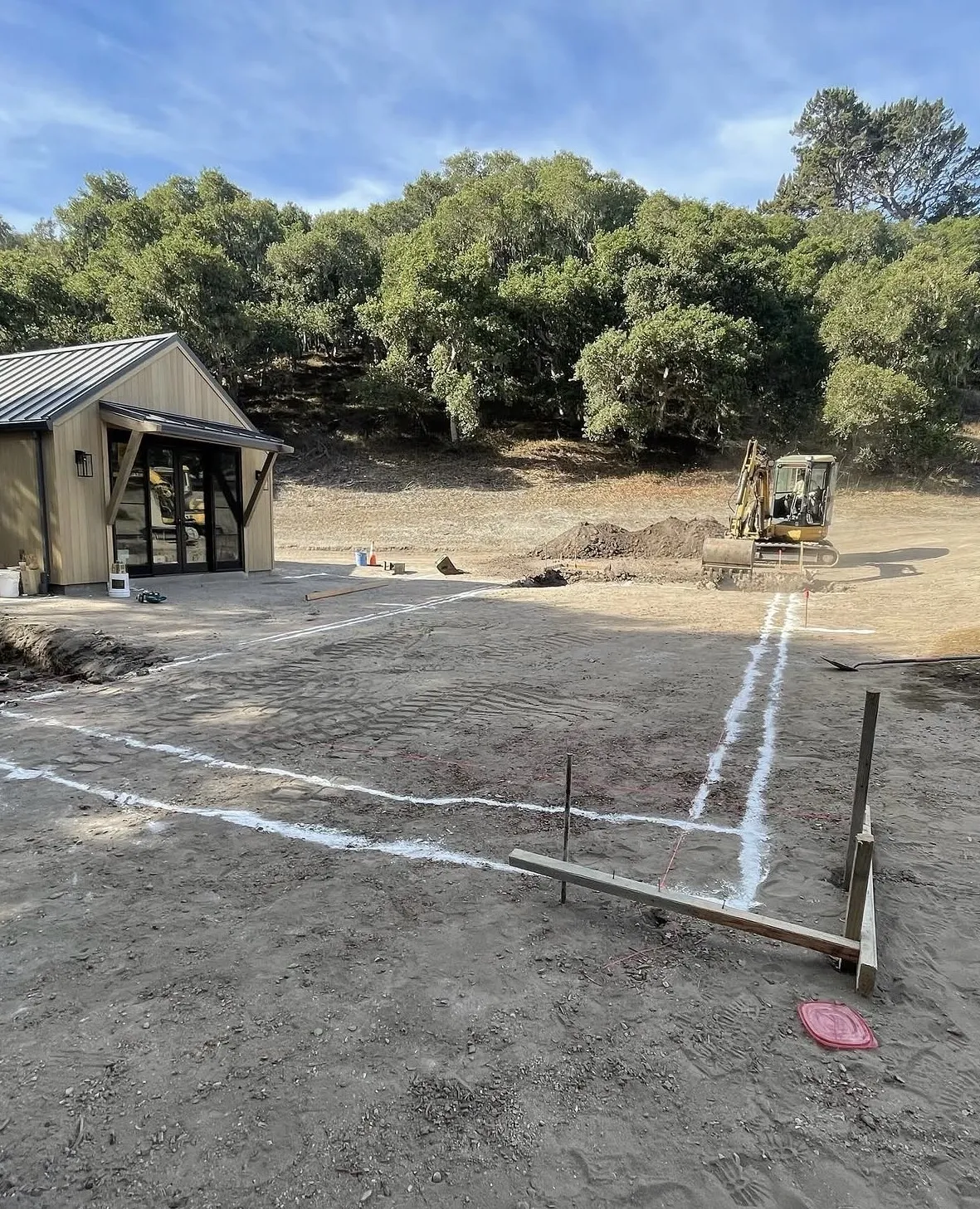
Layout day
The pool is painted on the ground. Take fifteen minutes and stand in it. This is your last free chance to move it.
Excavation
A machine, a crew and trucks. The hole appears in a day or two on a straightforward site. Expect noise, expect dust, and expect the yard to look worse than you imagined — this is the low point and everything after it is improvement.
If access is tight the machine may be smaller, or the dig may be partly by hand and conveyor. That is slower, and we will have told you about it before you signed.
Steel and plumbing
Quieter, slower, and the most consequential week of the build. Reinforcing steel is tied, pipe is run and pressure-tested, conduits are set. It looks like very little is happening. What is happening is everything that will be inaccessible forever afterwards.
Shell day
One long, loud day. A pump truck, a hose and a crew placing and carving concrete continuously from morning. At the end of it there is a pool-shaped structure in your yard. Then it is water-cured for several days, which means someone wets it down on a schedule — often you, and we will show you how.
Tile, coping and masonry
Detailed, quiet work by a small crew. This is when the pool starts to look like the drawings.
Decking
Forming, base preparation, pour and finish. Decking is also where yard drainage is resolved, so the finished grade sheds water away from the house and the pool.
Equipment and electrical
The pad is built and plumbed, the electrical is run and bonded, and inspections happen. Bonding — tying every piece of metal around the pool into one electrical plane — gets inspected before it is covered.
Interior finish
The shell is prepped and the plaster, quartz or pebble interior goes on. Another single-day, all-hands operation.
The first month of water
A new interior finish cures underwater, and what happens in the first weeks determines how it looks for the rest of its life. This phase is not padding.
The fill
The pool is filled in one continuous fill, from the bottom, without stopping. A stop-start fill can leave a visible ring in a fresh finish that never comes out.
Startup chemistry
Fresh plaster releases material into the water and moves the chemistry around for weeks. Startup is a managed sequence of brushing and staged balancing — not simply dumping chlorine in and walking away.
Brushing matters more than anything you can buy. It knocks down plaster dust before it can settle and cement itself into the surface.
Handover
We walk you through the equipment, the automation, the valves, what each one does and what the pool needs week to week. You get the paperwork: permit sign-off, equipment manuals and warranties.
Settling in
A new pool is not finished on handover day. Expect to adjust run times as the seasons change, and expect to learn your own pool. If you would rather not, ongoing maintenance is something we do.
What we need from you
Short list, and every item on it is something only you can do.
- AccessA clear route for equipment and trucks on the days we have agreed, and somewhere for a crew to park.
- Decisions on timeSelections finished before excavation wherever possible. A held-up tile choice can idle a crew.
- Water for curingA working hose bib, and someone to wet the shell on schedule during curing if that has been agreed.
- Pets and small children kept clearAn open excavation, a trench full of pipe and a wet deck are all genuine hazards.
- Someone to say yesOne point of contact who can make a call the same day when something on site needs one.
Process questions
How long does it take to build a pool?
It depends on your site, your jurisdiction’s permit timelines and the weather, and we will give you a schedule for your project once we have walked it and know the permit path. Be sceptical of any builder who quotes an exact number of weeks over the phone before seeing the yard.
Can I use the yard while you build?
Partly. There will be periods — excavation, shell day, the deck pour — where the yard is a working site and off limits. We will tell you which days those are in advance.
Do I need to be home?
Not most days. You should be there for the site walk, for layout day, ideally for shell day, and for handover. Everything else we can run with a phone call.
What if it rains?
Excavation, decking and the interior finish are all weather-dependent. Rain during an open excavation is the most disruptive, because the hole has to be dewatered and the sides checked before work resumes. We build a realistic allowance into winter schedules rather than pretending the Central Coast is dry.
Who deals with the inspections?
We do. We pull the permit, call the inspections and meet the inspector. You get the signed-off permit at handover, which matters when you eventually sell the house.
Free estimate
Tell us about the yard
Send a few photos and roughly what you have in mind, and we will tell you what is realistic on your site. Estimates are free and there is no obligation.