
Cost
Pool Cost on the Monterey Bay: What Actually Drives the Number
We are not going to print a price range on this page, because a range wide enough to be honest is too wide to be useful. What we can do is tell you exactly which decisions move the number, and by roughly how much relative to each other.
- Written by Supreme Pools · CSLB #1079748
- Regulatory claims linked to official sources
- Last checked September 12, 2026
Why nobody can quote you over the phone
Two identical pools, drawn on the same sheet of paper, built two streets apart, can differ in cost by more than the price of a car.
That is not a sales evasion, it is arithmetic. The pool itself — the shell, the plumbing, the finish — is a reasonably predictable cost. What varies enormously is everything the site imposes on top of it: how machinery reaches the yard, what has to come out to let it, what is in the ground, what the ground does, how far the equipment pad sits from the water, and what your jurisdiction requires before it will issue a permit.
Any contractor who gives you a firm number before walking the site is either padding heavily to cover the unknowns or setting up a change order. Both cost you money; the second also costs you the ability to compare quotes.
So here is the useful version: the things that actually move a pool budget, roughly in order of how much they move it.
The things that move the number most
Access
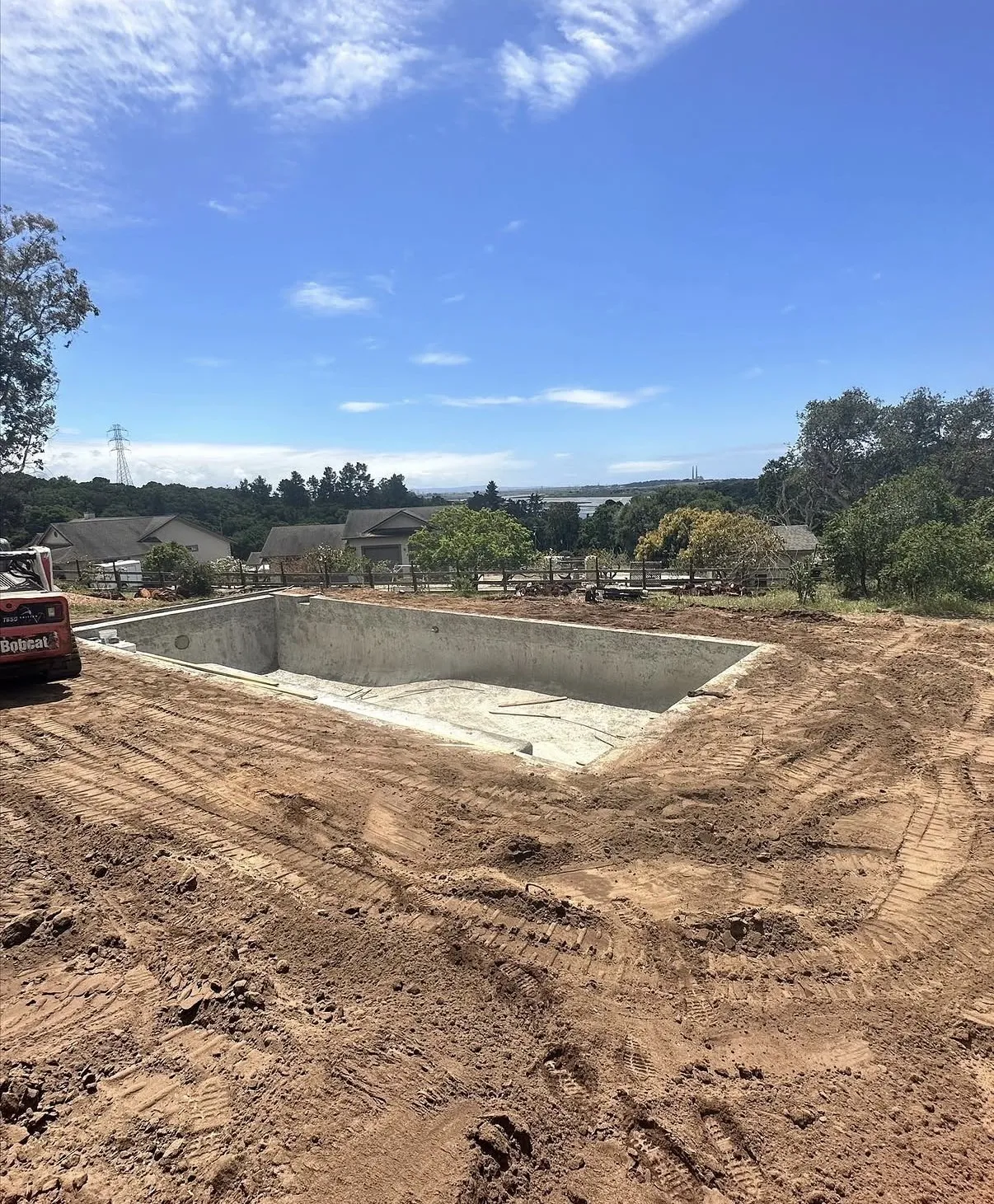
The single most underestimated line item on the Central Coast. A yard an excavator can drive into, with somewhere to put spoil, is the cheapest site there is. A yard reachable only through a four-foot side gate means a smaller machine, hand digging, conveyor spoil removal and far more labour hours — and sometimes taking out and rebuilding a fence or a section of wall.
Older Monterey, Pacific Grove and Santa Cruz lots are frequently in the second category. Newer Salinas, Marina and Gilroy subdivisions are usually in the first.
Grade
A flat yard takes a flush pool with a simple deck. A slope means retaining, engineered structure, more steel and more concrete, and generally a geotechnical report behind it. A hillside pool is a retaining wall that happens to hold water, and it is priced like one.
What is in the ground
Rock, buried debris, an old foundation, expansive clay, a high water table, a utility nobody knew about. Some of this is discoverable in advance, some genuinely is not. Good contractors tell you which is which and how it would be handled.
Size, and specifically perimeter
Cost tracks surface area and perimeter more than volume. A deeper pool costs somewhat more to dig and a good deal more to heat; a longer pool costs more in shell, coping, tile and finish all at once. If the budget is tight, the lever that hurts least is usually depth, not length.
Decking
Routinely underestimated, and frequently as large a number as people expect the pool itself to be. A generous deck in a good material is the difference between a pool and a yard, and it is worth budgeting properly rather than treating as what is left over.
Interior finish
White plaster is the least expensive and the shortest-lived. Quartz blends cost more and last longer. Pebble costs most and is the most durable. The gap between them is real, and in hard-water areas the harder finishes earn it back.
The equipment pad
A variable-speed pump, a properly sized filter, a heater matched to the pool, sanitising and automation. Choosing a heater is the biggest single decision here, and on the coast it is not optional.
Features
A spa is the largest single feature cost and the one most people are happiest they paid for. Vanishing edges add structure, a basin and a second pump. Tanning ledges cost swimming area more than money. Bubblers and spillovers are cheap during rough-in and expensive afterwards.
Approvals
Permit and plan-check fees, plus whatever your jurisdiction requires: a geotechnical report, a design study, a coastal development permit, a tree permit. These vary more by city than by pool, which is why the same pool costs differently in Carmel than in Salinas.
Where people waste money
Depth. A pool deeper than about five feet buys you almost nothing unless you are genuinely diving, and it costs you excavation, shell, water, chemicals and heat forever. Most families would be happier with a long shallow end and the money spent on the deck.
Undersized plumbing. It saves a few hundred dollars in a trench that is already open and costs you every month for the life of the pool in a pump working harder than it needs to. This is the clearest example of a cheap decision that is not a saving.
Skipping the cover. On this coast, a cover is the difference between a pool you use and a pool you look at, and California requires one anyway on an outdoor pool with a gas heater or heat pump. Treating it as an optional extra is how people end up with a heating bill they resent.
Buying the biggest pool the yard will hold. A pool crammed to the setbacks with no room to walk around it or put a table is a worse yard than a smaller pool with a proper deck. The water is not the amenity; the outdoor room is.
How to compare two quotes properly
Price alone tells you very little, because two quotes are rarely for the same thing. Put them side by side and check what each one actually includes: the pipe size and the number of returns, the pump and whether it is variable speed, the filter size, the heater output, the interior finish product, the tile allowance, the square footage and material of decking, whether the electrical and gas runs are in, whether spoil haul-off is in, whether permit fees are in, and what the safety feature provision is.
You will usually find the cheaper quote is cheaper because something is missing, and it is almost always one of decking area, equipment specification, or the electrical and gas runs. Neither is dishonest, necessarily — but you cannot compare them until they are the same scope.
It is also worth asking the questions in questions to ask any pool builder, which includes the ones we would rather you asked us.
Cost questions
How much deposit will I be asked for?
On a California home improvement contract, the down payment may not exceed $1,000 or ten per cent of the contract price, whichever is less. That is statutory. A contractor asking for a large up-front payment is a warning sign, not a negotiating position.
Is a remodel much cheaper than a new pool?
Substantially, because the expensive structural work already exists. The shell stays; the finish, tile, coping, decking, plumbing and equipment are what get renewed. It is the best value in the industry when the shell is sound.
What is the cheapest way to get a real pool?
A modest rectangle on a flat, accessible lot, with a simple deck in a good material, a decent interior finish, correctly sized plumbing and a cover. Spend on the invisible things and keep the footprint honest. That pool will outlast and out-perform a larger one built to the same budget.
Does a pool add value to the house?
It depends on the property, the neighbourhood and the pool, and anyone who tells you a flat percentage is making it up. What is more reliably true is that a well-built pool is an asset and a badly built one is a liability a buyer will discount for.
Where these facts come from
- California Business and Professions Code § 7159Checked September 12, 2026
- City of Gilroy — Swimming Pool and Spa Submittal Guidelines (citing California Energy Code § 110.4(b)(2))Checked September 12, 2026
Free estimate
Tell us about the yard
Send a few photos and roughly what you have in mind, and we will tell you what is realistic on your site. Estimates are free and there is no obligation.