
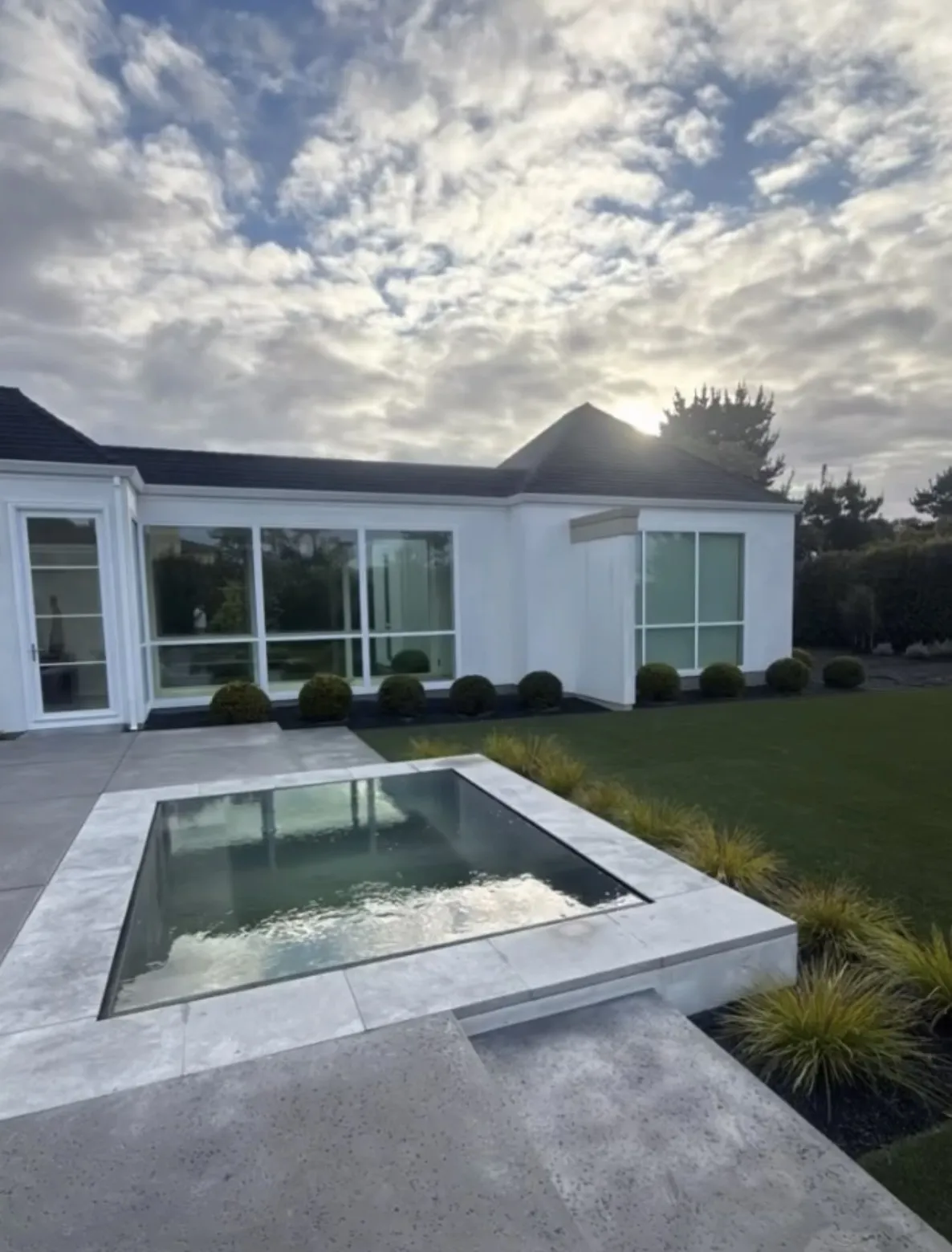
Small lots
Getting a Real Pool Out of a Small Yard
Most of the older housing stock on the Monterey Peninsula, in Pacific Grove and around Santa Cruz sits on lots that will not take a big pool. That is a design constraint, not a disqualification, and the pools that come out of it are frequently better than the ones that do not have it.
- Written by Supreme Pools · CSLB #1079748
- Regulatory claims linked to official sources
- Last checked September 12, 2026
The mistake is scaling down, not designing small
A small pool is not a big pool with the dimensions reduced. It is a different problem with different right answers.
Take a standard family pool, shrink it until it fits, and you get something that reads as compromised: too short to swim, too shallow to feel like water, with a deck too narrow to stand on and a spa crammed into a corner. Everyone can see what it was trying to be.
Design for the space instead and you get something that reads as deliberate. A plunge pool with a bench the full length of one side. A narrow lap pool running the length of a boundary. A pool and spa treated as one composition rather than two objects. These are complete ideas at their own scale, not reductions of something else.
The other shift is to stop treating the water as the whole amenity. On a small lot the outdoor room is the product, and the pool is one element in it alongside deck, shade, planting and light. Get that proportion right and a modest pool makes a small yard feel larger. Get it wrong and a large pool makes it feel like a pool with a path round it.
What earns its space on a small lot
- A spaThe highest use per square foot of anything you can build, and on this coast it works in the months the pool does not. Flush-set keeps sightlines open where a raised spa would cut the yard in two.
- A full-length benchTurns a short pool into somewhere people sit in the water rather than swim lengths, which on a small lot is what will actually happen.
- A dark interior finishMakes water read deeper and the pool feel larger, and absorbs more solar gain, which is useful in a fog-belt yard.
- Good lightingA small pool lit well is the best thing in the garden after dark, and it extends the hours the yard is used.
- An automatic coverSafety, heat and water in one item, and a rectangle takes one cleanly. It also makes a small pool disappear when it is not in use.
- A generous deck on one sideBetter than a narrow path all the way round. Pick the side with the afternoon sun and make it wide enough for furniture.
What to cut
- DepthAnything beyond about five feet costs you excavation, heating and chemicals and buys you almost nothing. It is the least painful thing to reduce.
- A large tanning ledgeLovely on a big pool, and on a small one it eats the swimmable area. A wide bench often does the same job for less.
- Rock waterfallsToo loud at close range in a small yard, and dry rock whenever the pump is off.
- A vanishing edgeIt needs a fall beyond the pool and a raised viewing position. Most compact urban lots have neither, and without them you are paying for a wall.
- Diving provisionIt imposes specific depth and shape requirements that will consume the whole pool on a small lot.
- A path all the way roundCirculation on four sides wastes the space that could have made one side genuinely usable.
The practical constraints on a small lot
Setbacks usually decide the footprint before taste gets a say. Your jurisdiction sets how close the water and the equipment can sit to a property line, and on a compact lot those numbers, minus a deck you can actually use, are what is left. That is worth establishing with your city at the very start, because it turns an open question into a defined one.
Equipment placement is the other constraint, and on a tight lot it is a neighbour question as much as a design one. A variable-speed pump runs slowly and quietly most of the time, which helps enormously, and siting and screening handle the rest. Deciding this during design is free.
Access is the third. Older small lots frequently have no vehicle route to the rear, which means a smaller machine, hand digging and conveyor spoil removal. It is normal work here. It costs more than driving an excavator in, and it should be priced honestly before you commit rather than discovered on day one.
Small pool questions
What is the smallest pool worth building?
Smaller than most people think, if it is designed for its size. A plunge pool with a bench and a spa gets used constantly; a badly proportioned pool twice the size gets used less. The threshold is about whether the design is complete at that scale, not about a dimension.
Can I still have a spa?
Yes, and on a small lot a spa is usually the highest-value thing you can build. Flush-set into the deck keeps the sightlines open. Attached to the pool it shares equipment and structure, which keeps the cost down.
Will a small pool feel cramped?
Only if it is designed as a shrunken large pool. A simple geometry, a bench the full length of one side, a darker interior finish and a properly sized deck on the sunny side make a compact pool feel generous rather than apologetic.
Is a small pool cheaper to run?
Yes, on every count — less water, less heat, fewer chemicals and a smaller pump. Combined with a cover, a compact pool is genuinely inexpensive to own, which is worth weighing against the instinct to build as large as the lot allows.
How do I know what will fit?
Establish the setbacks with your city, subtract a deck you would actually use, and see what is left. Then mark it on the ground with paint and live with it for a week. That exercise answers the question better than any drawing.
Free estimate
Tell us about the yard
Send a few photos and roughly what you have in mind, and we will tell you what is realistic on your site. Estimates are free and there is no obligation.