
Pool & spa
Pool and Spa, Designed as One System
An attached spa is the most-used feature on most pools, because it works in February. The design question is not whether to have one — it is whether it should share the pool’s plumbing or stand on its own.
- CSLB #1079748 · C-53 Swimming Pool
- Based in Salinas, working the Monterey Bay
- Monday to Saturday, 8am to 5pm
Why a spa changes how much you use the pool
On the Central Coast the swim season is finite and the spa season is not.
A pool in Monterey or Santa Cruz is genuinely comfortable for part of the year without heating, and heated for the rest of it at a cost that depends on wind, cover and how warm you like it. A spa is small, insulated by its own volume and reaches temperature quickly, which means it works on a foggy evening in January when the pool does not.
That asymmetry is the practical argument for an attached spa, and it is also the argument for thinking carefully about how it is plumbed. A spa sharing the pool’s heater is cheap to build and means firing a heater sized for tens of thousands of gallons to warm a few hundred. A spa with its own dedicated loop — or a system with proper isolation valves and a controller that knows the difference — can be run hot on its own without heating anything else.
This is exactly the sort of decision that is free during design, cheap during rough-in and effectively impossible afterwards.
The three arrangements
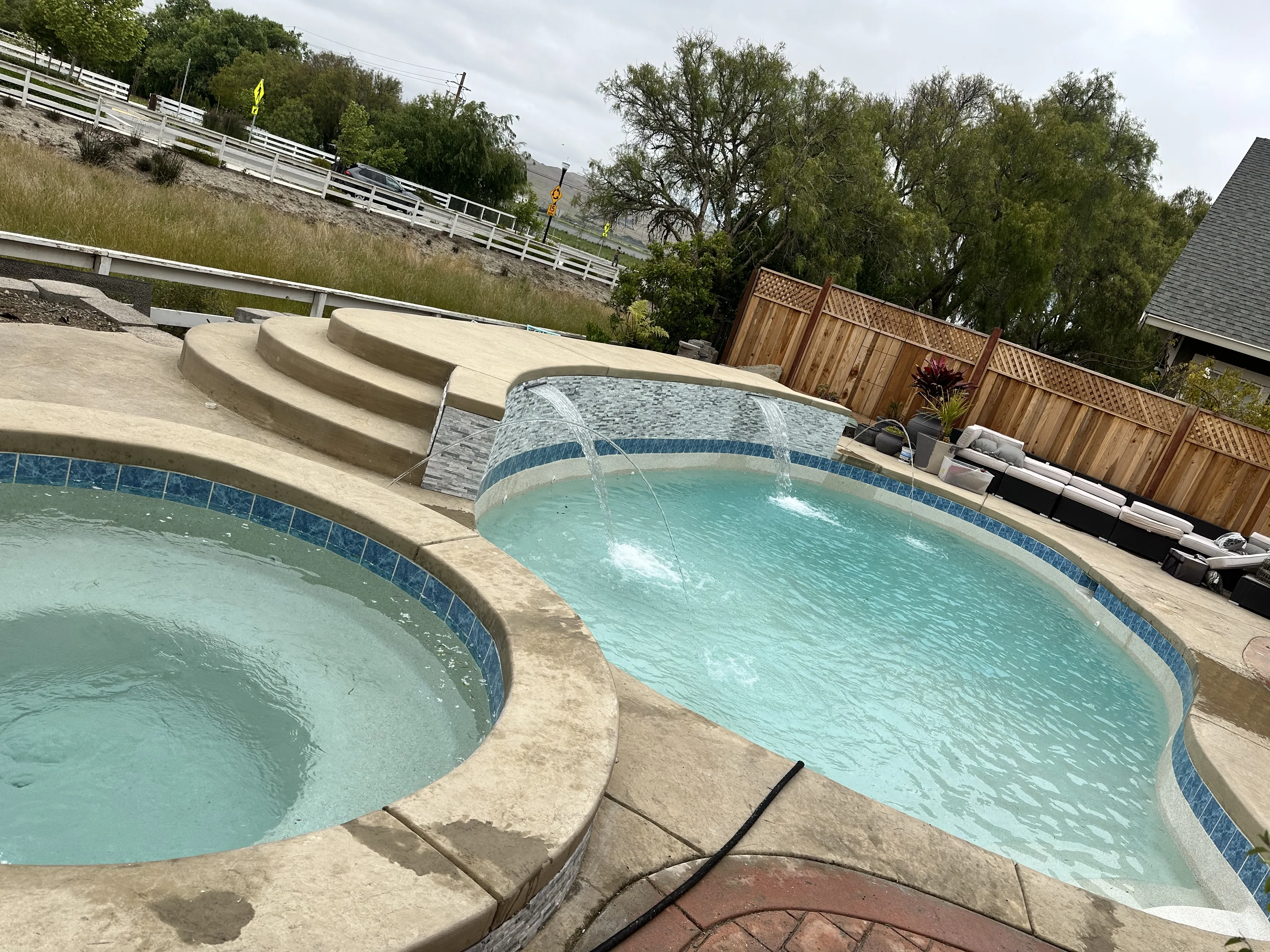
- Attached, spilling into the poolThe common choice. A raised or flush spa shares a wall with the pool and spills over a dam wall. Shares structure, plumbing and equipment. The spillover keeps the pool surface moving and sounds good from the house.
- Attached, flush and isolatedSet into the pool deck at the same level with a shared wall but valved separately. Cleaner lines, less noise, and the ability to run the spa without warming the pool.
- DetachedA separate structure, often positioned for a view or shelter the pool cannot get. Own equipment, own cover, genuinely usable year round — and it costs like a second, small pool.
What the spillover actually does
A spillover is not decoration, although it is that too. Water leaving the spa over a dam wall into the pool is surface water in motion, and moving surface water skims better, distributes sanitiser more evenly and discourages the still corners where debris and biofilm collect.
It also gives you sound. On a Peninsula property where the ambient noise is wind in pines and a distant road, a low spillover changes the character of a yard more than almost any other feature — and unlike a tall waterfall, it does so without a pump running hard enough to hear at the pad.
The trade-off is heat. Water spilling out of a heated spa into an unheated pool is heat leaving the spa. Which is why a spillover you can turn off — a valved arrangement rather than a permanent overflow — is worth specifying.
Pool and spa questions
Can I heat the spa without heating the pool?
Yes, if it is designed that way. It needs isolation valves, typically actuated, and a controller that can run a spa-only mode. Retrofitting that to a pad plumbed as a single loop is possible but involves re-plumbing, so it is worth specifying up front.
How long does a spa take to heat up?
Far less time than a pool, because the volume is a fraction of it — this is the whole practical case for a spa. Actual time depends on the heater, the starting temperature and whether the spa has a cover, and a cover makes a very large difference.
Should the spa be raised or flush?
Raised gives you a spillover, a visual anchor and seating at deck height; flush gives you cleaner lines and an uninterrupted view across the water, which matters on a view lot. Raised is more common, flush suits modern architecture, and both are structural decisions made before shell day.
Can you add a spa to my existing pool?
Yes. New gunite tied into the existing shell, new plumbing back to the pad, and usually a heater review. It is one of the most transformative things that can be done during a remodel.
Is a spa expensive to run?
The running cost is dominated by heat loss from the surface, which means a properly fitting cover is the single biggest lever. An uncovered spa held at temperature is expensive anywhere; a covered spa is much less so.
Free estimate
Tell us about the yard
Send a few photos and roughly what you have in mind, and we will tell you what is realistic on your site. Estimates are free and there is no obligation.