
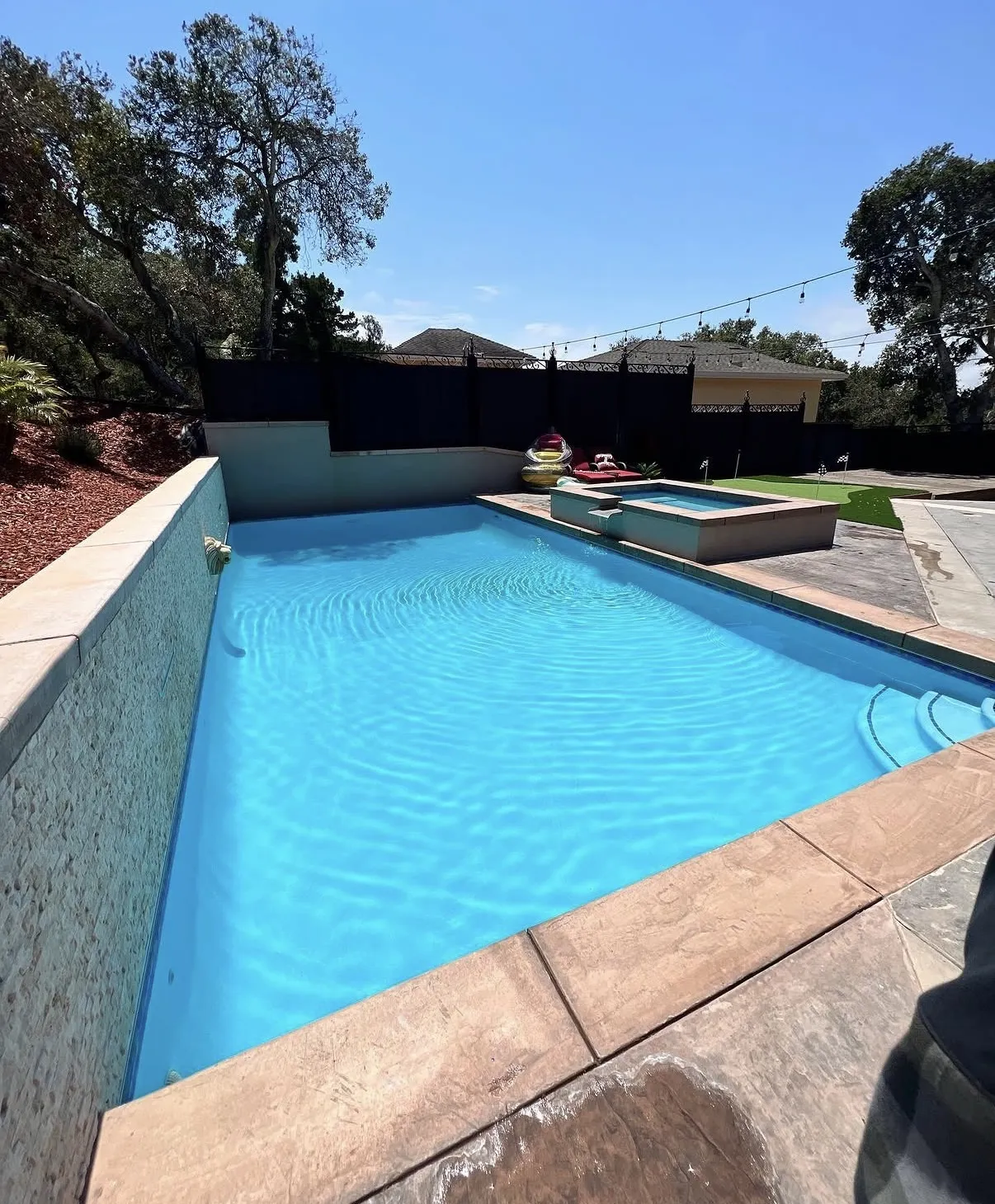
Water features
Water Features, Chosen by Sound
Every water feature is a pump moving water so it can fall back down. What separates them is how they look when still, how they sound when running, and how much energy that costs.
- CSLB #1079748 · C-53 Swimming Pool
- Based in Salinas, working the Monterey Bay
- Monday to Saturday, 8am to 5pm
Choose for the sound, not the photograph
Water features are usually specified from images. They are experienced almost entirely as noise.
A tall waterfall looks dramatic in a photograph and is loud enough in a small yard to make conversation at the table harder. A low spillway from a raised spa reads as almost nothing in a picture and produces exactly the soft, continuous sound most people actually wanted. These are very different products sold as the same thing.
The useful test is to think about where you will be sitting, how far from the feature, and whether you want to hear it while talking or only while lying down. Then pick the feature that makes that sound, at that distance.
The second consideration is what it looks like turned off, because most features are off more than they are on. A sheer descent with the pump off is a clean slot in a wall. A rock waterfall with the pump off is dry rock. One of those is a design element in both states and the other is not.
The common features, compared honestly
| Feature | Sound | Notes |
|---|---|---|
| Spa spillover | Low, continuous murmur | The default, and the one most people are happiest with. Keeps the pool surface moving. Costs nothing extra if the spa is already there. |
| Sheer descent | Even, broad, moderate | A wide clean sheet from a slot in a raised wall. Modern-looking, and tidy when off. Needs a dead-level lip and its own supply line. |
| Scupper or spout | Distinct, splashy, punctuated | Individual streams from a raised wall. Reads traditional or contemporary depending on the fitting. Easy to specify in multiples. |
| Bubbler | Soft gurgle, close range | Set into a tanning ledge. Best value feature for families, and children use it constantly. |
| Deck jet | Light arcing splash | Arcs from the deck into the pool. Cheap to add during rough-in, and wind will blow it off target on an exposed site. |
| Rock or grotto waterfall | Loud, dominant | Genuinely impressive and genuinely loud. Needs a large pump and substantial structure, and is dry rock when it is off. |
What they cost to run
A water feature is a second hydraulic circuit. Some run off the main pump through a diverter valve, which costs nothing extra in equipment but means the main pump has to run faster than filtration alone requires whenever the feature is on. Others get a dedicated pump, which is better because the feature can run at its own speed independently of filtration, and worse because it is another pump.
The variable that dominates is height and volume. A low spillway moving a modest amount of water a short distance is close to free. A tall waterfall lifting a large volume several feet is not, and it is worth knowing that before rather than after.
All of them increase evaporation, because moving water in air evaporates faster than still water. On a windy coastal site a big feature running continuously is a measurable amount of water. Most owners settle into running features on a schedule, which is one of the genuinely useful things automation does.
Water feature questions
Which water feature is the quietest?
A low spa spillover, by a distance. It produces continuous soft sound without the splash of a fall from height, and because the spa is usually already there it adds nothing to the equipment.
Do water features help keep the pool clean?
Indirectly. Moving surface water skims better and distributes sanitiser more evenly, so a feature that agitates the surface does help. It is not a substitute for filtration or circulation.
Can water features be added later?
Only if the plumbing was run. The pipe has to come from the equipment pad to the feature, and after the deck is poured that means cutting concrete. Stubbing out a capped line during rough-in is the cheap insurance.
Will hard water leave deposits on them?
On any wetted surface that is repeatedly exposed to air, yes, mineral deposits are more visible than on submerged surfaces — and more so where source water is harder. Keeping water balanced is the defence, and a feature that can be turned off is easier to clean.
Do they make the pool colder?
Slightly, yes. Water thrown through air loses heat and increases evaporation, which is the largest heat loss a pool has. If you are heating the pool, running a large feature continuously works against you.
Free estimate
Tell us about the yard
Send a few photos and roughly what you have in mind, and we will tell you what is realistic on your site. Estimates are free and there is no obligation.