
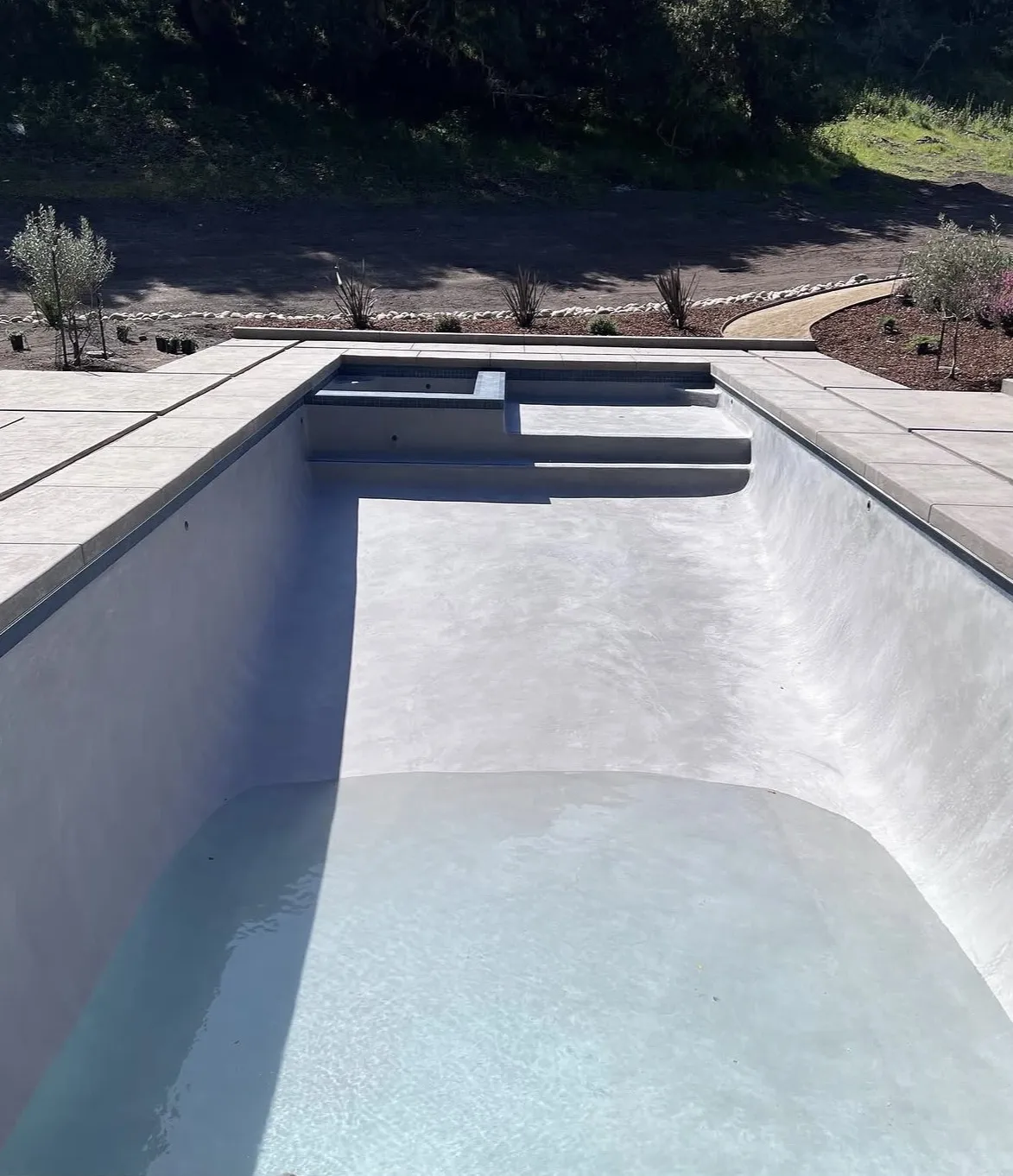
Resurfacing
Pool Resurfacing and Replastering
Resurfacing is the maintenance event every concrete pool eventually has. Done at the right time, with the right finish and a proper startup, it resets the pool for another long stretch.
- CSLB #1079748 · C-53 Swimming Pool
- Based in Salinas, working the Monterey Bay
- Monday to Saturday, 8am to 5pm
Why a pool surface wears out
The interior finish is a sacrificial layer. It is meant to wear; the only question is how fast.
Plaster is a thin cementitious coat bonded to the gunite shell. It is porous, it is alkaline, and it sits permanently in treated water. Water that is even slightly aggressive dissolves calcium out of it; water that is slightly scaling deposits calcium onto it. Both leave a surface that is rougher, patchier and more chemically demanding than it was, and each year the trend accelerates because a rough surface holds more of whatever is attacking it.
That is why two identical pools plastered on the same day can be a decade apart in condition. It is not the product. It is a thousand small chemistry decisions made or not made over the years in between.
The practical consequence: get the finish replaced when the surface tells you to, not on a schedule, and then protect the new one with water that stays in range.
Signs the finish is done
One of these alone is worth watching. Several together mean it is time.
- Rough underfootA surface that scrapes feet and swimsuits. Plaster that has lost its smooth skin only gets rougher.
- Staining that will not brush outEspecially mottled grey or brown patches that return after treatment.
- Exposed aggregateVisible pebbles or sand in a finish that was smooth. The surface layer has gone.
- ChalkingA white residue on hands and swimsuits, and water that is persistently slightly cloudy.
- Chemical demand that keeps climbingA porous surface consumes sanitiser and acid faster every year.
- Craze cracking or delaminationFine surface crazing is often cosmetic. Hollow-sounding areas or flakes lifting are not, and need a look.
How a resurfacing runs
Drain and inspect
The pool is drained and the shell is inspected properly for the first time in years. This is also when we find anything that has to be dealt with before a new finish goes on — a plumbing leak, a failed light niche, a cracked skimmer throat.
Draining a pool is not risk-free. In ground with a high water table a drained shell can be pushed by hydrostatic pressure, which is why the hydrostatic relief valve is checked and the timing matters.
Chip out and prepare
The old finish comes off back to sound gunite, and the shell is prepared so the new coat bonds rather than sits. Preparation is the difference between a finish that lasts and one that delaminates in three years.
Tile and fittings
Waterline tile off and replaced, fittings and main drain covers renewed. Almost everyone replaces the tile at this point, because a new interior finish changes the water colour and old tile rarely still works against it.
Apply the finish
Plaster, quartz or pebble, applied in one continuous operation and trowelled or exposed depending on the product.
Fill and start up
One continuous fill, immediately followed by the startup routine: daily brushing and staged chemistry while the new surface cures underwater.
This is the part people skip and regret. A finish that is brushed and balanced properly for its first month looks materially better ten years later than one that was not.
Choosing a finish
Three families of product, with genuinely different trade-offs. Look at samples wet, outdoors, at your pool.
| Finish | Feel and look | Trade-off |
|---|---|---|
| White marble plaster | Smooth, bright, the classic pale-blue water. Lowest cost. | Shortest service life and the least forgiving of chemistry drift. Shows staining first. |
| Quartz blend | Smooth with a fine sparkle; wider and more stable colour range. | Costs more than plaster. Harder and more colour-stable, and a sensible middle choice. |
| Pebble | Natural aggregate, visible texture, deep water colour, very durable. | Highest cost, and textured underfoot — which some people love and some find harsh on bare feet. |
Resurfacing questions
How long does a resurfacing take?
It is a contained job compared with a remodel — drain, chip, prep, tile, finish, fill and start up — but the range depends on the pool and on whether anything is found once it is drained. We will give you a schedule when we have seen it.
Can you change the colour?
Yes, and it is the easiest way to transform a pool. Remember that the water takes its colour from the finish: darker finishes read deeper and absorb more solar gain, lighter finishes read brighter and show the bottom more clearly.
Do I have to replace the tile too?
Not technically, but most people do. A new finish changes the water colour, and tile that looked right against the old surface often looks wrong against the new one. The tile is also easiest to replace while the pool is drained.
Is it safe to leave the pool empty?
Only for as long as the work requires, and with the hydrostatic relief valve checked. An empty shell in saturated ground can be lifted by groundwater pressure. This is a real consideration in low-lying and high-water-table ground, and it is one of the reasons resurfacing is not a DIY job.
What is the startup routine and do I have to do it?
Daily brushing and staged chemical adjustment for roughly the first month while the new surface cures. We will either do it as part of the job or show you exactly how, and it genuinely determines how the finish ages.
Free estimate
Tell us about the yard
Send a few photos and roughly what you have in mind, and we will tell you what is realistic on your site. Estimates are free and there is no obligation.