
Materials
Gunite vs. Shotcrete: What Actually Differs
Both build a monolithic concrete pool shell. Both are used routinely on residential pools in California. The real difference is where the water is added, and almost everything else you will read on this subject is a builder defending the equipment they own.
- Written by Supreme Pools · CSLB #1079748
- Regulatory claims linked to official sources
- Last checked September 12, 2026
The actual distinction
Both are pneumatically applied concrete. They differ in when the water meets the mix.
With gunite — the dry-mix process — the cement and aggregate arrive dry and travel dry through the hose. Water is introduced at the nozzle, controlled by the operator, at the moment of placement. With shotcrete — the wet-mix process — the concrete arrives already batched and mixed as ready-mix, and is pumped through the hose as wet material.
Everything else follows from that one difference. Dry mix puts the water content in the hands of the nozzleman, which means a skilled operator has moment-to-moment control and an unskilled one can get it wrong. Wet mix has its water-cement ratio fixed at the batch plant, which means consistency is designed in and cannot be adjusted on the fly.
Both, correctly placed over a properly tied steel cage and properly cured, produce a monolithic structural shell that will last decades. This is the part the marketing tends to obscure.
The practical trade-offs
| Gunite (dry mix) | Shotcrete (wet mix) | |
|---|---|---|
| Water added | At the nozzle, by the operator | At the batch plant, before delivery |
| Mix consistency | Depends on operator skill | Fixed and verifiable by batch ticket |
| Scheduling | More tolerant of interruption; material can wait | Working to the delivered load and its set time |
| Site access | Often easier on constrained sites | Needs the pump and truck positioned |
| Rebound and waste | Typically higher | Typically lower |
| Dust on site | More | Less |
| Quality control | Rests on the crew | Rests on the crew and the batch plant |
What actually determines whether the shell is good
Not which of the two processes was used. The things that genuinely decide the quality of a pool shell are: whether the steel is correctly sized, spaced and held off the soil so concrete surrounds it completely; whether the material is placed without voids, particularly behind the steel and in the corners; whether it is carved and screeded to a consistent thickness; and whether it is properly water-cured afterwards.
A well-placed gunite shell beats a poorly placed shotcrete shell, and the reverse is equally true. Neither process rescues bad steel placement, and neither survives being skipped on curing.
So the useful questions to ask a builder are not "gunite or shotcrete". They are: how is the steel supported off the ground, how is the shell thickness verified, and how long is it cured and by whom. A builder who answers those confidently is worth listening to whichever nozzle they use.
Material questions
Which is stronger, gunite or shotcrete?
Correctly placed and correctly cured, both produce a structural monolithic shell that lasts decades. The variables that actually decide strength are the steel, the placement, the thickness and the curing — not which of the two processes was used. Treat a categorical claim either way as marketing.
Does it change how long the pool lasts?
Far less than the water chemistry does. The shell is the long-lived part of any concrete pool; what wears out is the interior finish on top of it, and that is governed by how the water has been kept over the years.
Is one cheaper?
It varies with the site, the crew and local material logistics rather than being categorically true. On a constrained site the access requirements can decide it, which is a practical reason rather than a quality one.
Why is it sprayed instead of poured?
Because a pool shell is a curved, variable-thickness structure with essentially no flat faces. Building forms for that would be slow and expensive, and on the pool floor impossible. Pneumatic placement lets the concrete take any shape the crew carves.
What happens after the shell goes on?
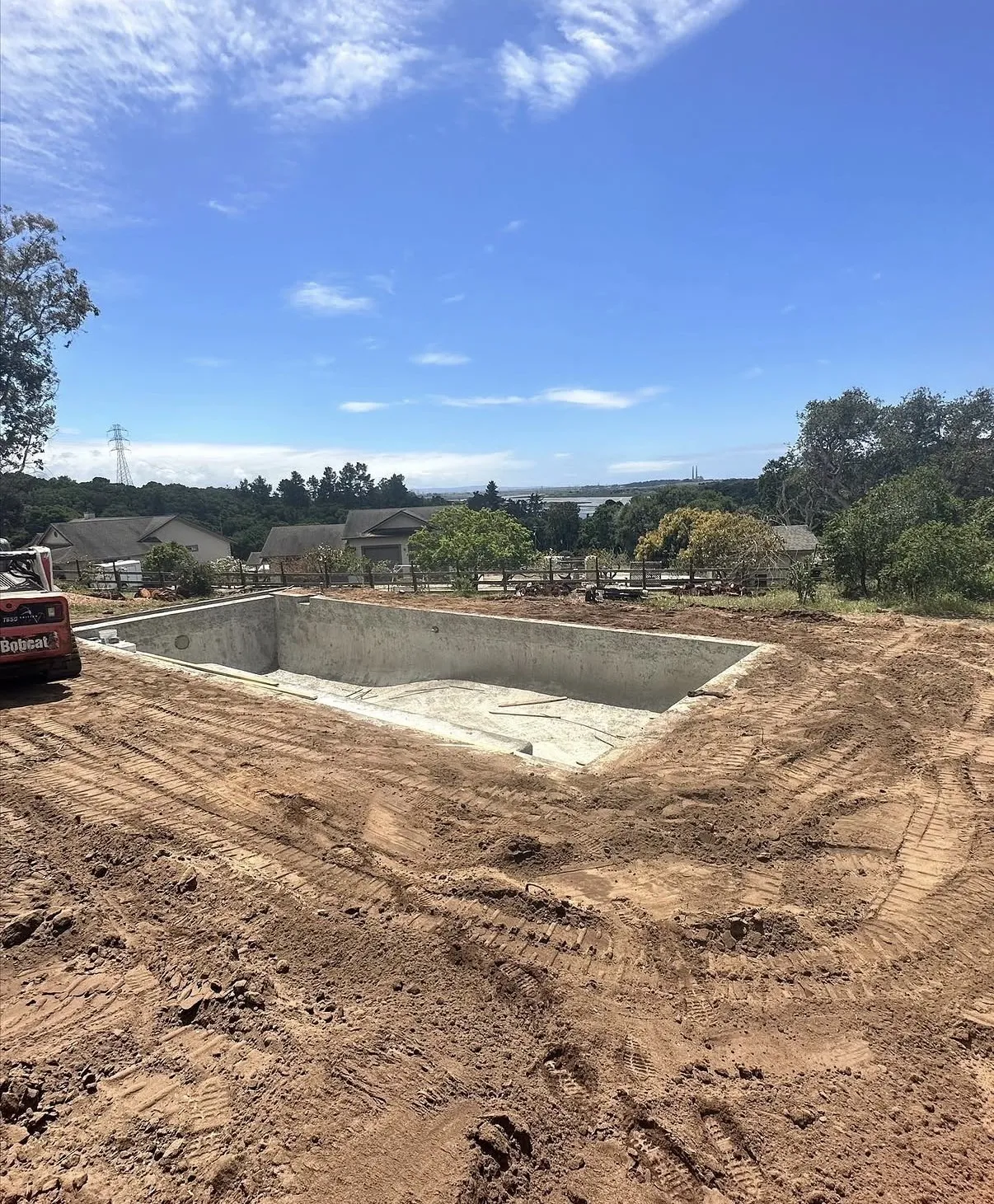
It is water-cured for several days — kept wet on a schedule while it gains strength. Then tile and coping, decking, equipment, the interior finish, and fill. The shell day is the most dramatic day of the build and it is roughly the halfway point.
Free estimate
Tell us about the yard
Send a few photos and roughly what you have in mind, and we will tell you what is realistic on your site. Estimates are free and there is no obligation.