
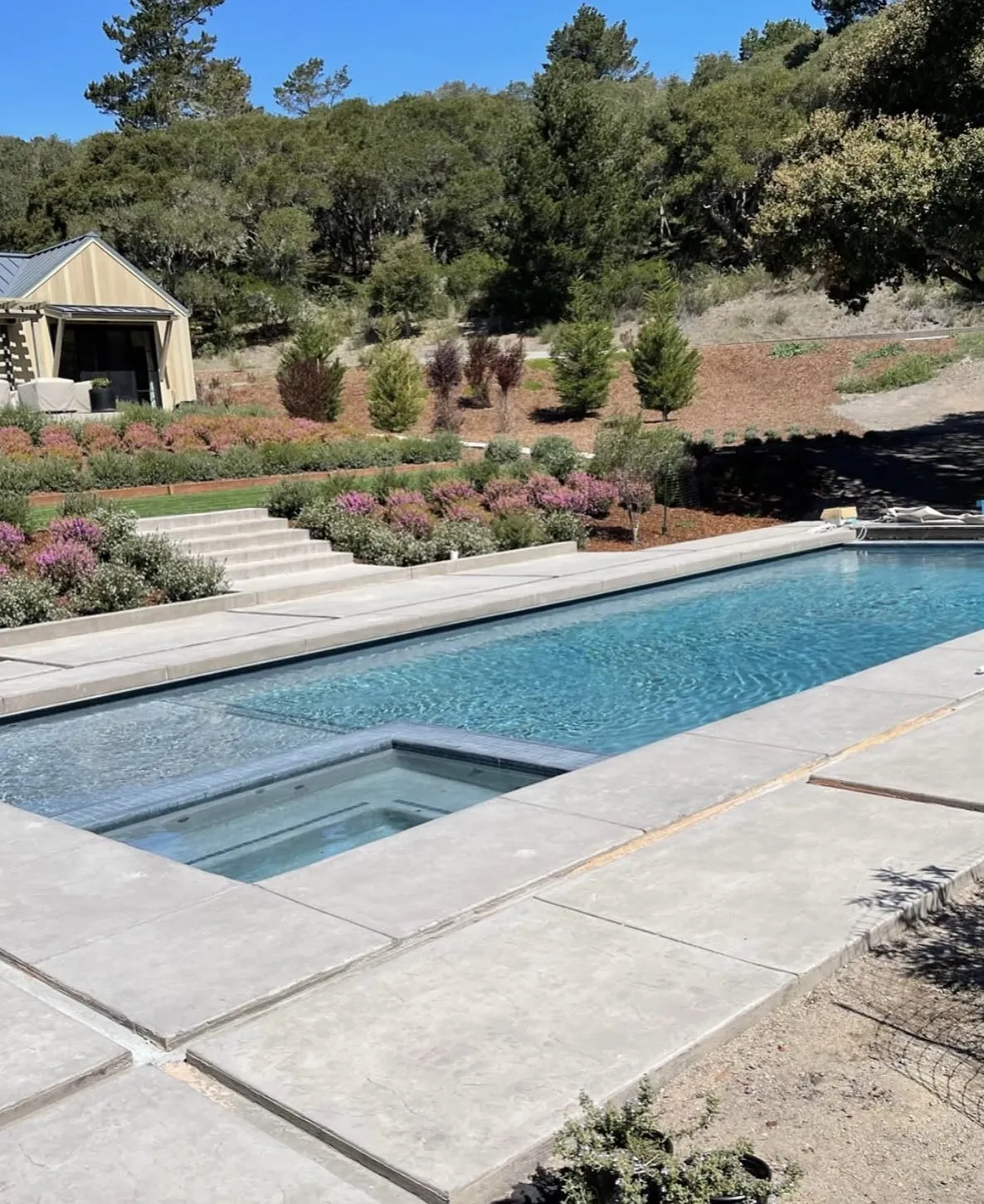
Hillside
Building a Pool on a Sloped Lot
A pool on a slope is a retaining structure that happens to hold water. That single sentence explains the cost, the engineering, the geotechnical report and — on the right lot — the view you are paying for.
- Written by Supreme Pools · CSLB #1079748
- Regulatory claims linked to official sources
- Last checked September 12, 2026
Why a slope costs what it costs
On flat ground, a pool holds water in and the soil around it holds itself up. On a slope, the pool has to do both jobs.
Cut into a hillside and the uphill side of the excavation is now a face of soil that wants to move. Build out from a hillside and the downhill side of the pool is a wall with nothing behind it but air, carrying the lateral load of the water pushing out and the structure pushing down. Either way the shell is resisting forces a flat-ground pool never sees, and it is engineered accordingly: more steel, thicker sections, deeper footings, and frequently a separate retaining structure.
That is the honest reason a hillside pool costs more than the same pool on a flat lot, and it is also why it is not a corner worth cutting. A structure designed for the actual soil, the actual slope and the actual seismic conditions is the difference between a pool and a liability.
It is also why geotechnical work is standard here rather than optional. The engineer designing your shell needs to know what the soil will do, and on a slope that information is not guessable from the surface.
What a hillside project adds
- Geotechnical investigationSoil borings and a report telling the engineer what to design for. Several local jurisdictions require it where slope or ground conditions warrant it.
- Structural engineeringA shell designed as a retaining structure, with the steel and thickness that implies.
- RetainingOften a separate retaining wall uphill or downhill of the pool, engineered and permitted in its own right.
- DrainageWater moving downhill has to be intercepted and taken somewhere. Subdrains and surface drainage are part of the design, not an afterthought.
- AccessGetting machinery and concrete to a sloping site is a logistics problem. Sometimes it means a pump truck reaching over the house.
- Spoil handlingMore material comes out of a hillside cut, and there is often nowhere on site to put it.
- Deck terracingA usable deck on a slope means steps, levels and often more hardscape than the pool itself.
- Longer scheduleMore engineering, more approvals, more structure. Plan for it rather than be surprised by it.
The compensation
Hillside lots are where the views are, and a pool positioned on one can do something a flat-lot pool cannot: put the water in the foreground of something worth looking at. That is the entire point of a vanishing edge, and it only works where ground falls away beyond the pool and you look at it from above.
Around here that means the Carmel Highlands and Del Monte Forest, the valley sides above Carmel Valley, the hills behind Santa Cruz and Aptos, and ridge parcels in the Santa Cruz Mountains. On those sites, the engineering you are paying for and the effect you are buying are the same expense.
Where a vanishing edge is not right, the slope still gives you something: a raised spa at the high end, terraced decks that make separate outdoor rooms, and the natural drama of water at a different level from where you are standing.
Hillside questions
How much more does a hillside pool cost?
Meaningfully more, and how much depends entirely on the slope, the soil and how much retaining is needed. The added cost is structure and engineering rather than finish, which means it buys you safety and durability rather than appearance.
Do I definitely need a soils report?
On a sloped lot, usually. Several jurisdictions in our area require geotechnical or geologic investigation where slope, seismic or ground conditions warrant it, and Carmel-by-the-Sea’s submittal requirements call for a geotechnical report and an engineer’s plan approval letter for projects involving structural components, retaining walls or deep excavation — which describes any pool.
Can you get equipment onto a steep site?
Usually, with planning. It can mean a smaller machine, a longer concrete pump reach, conveyor spoil removal, or staging from a neighbouring access. What matters is that the method is worked out and priced before work starts.
Is a vanishing edge worth it on a slope?
On a lot where the ground genuinely falls away beyond the pool and you view the water from above, yes — that is the one configuration where the detail does what the photographs promise. Without a fall and a raised viewing position, spend the money elsewhere.
What about drainage?
It is one of the most important parts of a hillside project and one of the least discussed. Water moving downhill has to be intercepted and directed somewhere safe, and a pool and its deck change how a slope sheds water. Subdrains and surface drainage belong in the design from the start.
Free estimate
Tell us about the yard
Send a few photos and roughly what you have in mind, and we will tell you what is realistic on your site. Estimates are free and there is no obligation.