
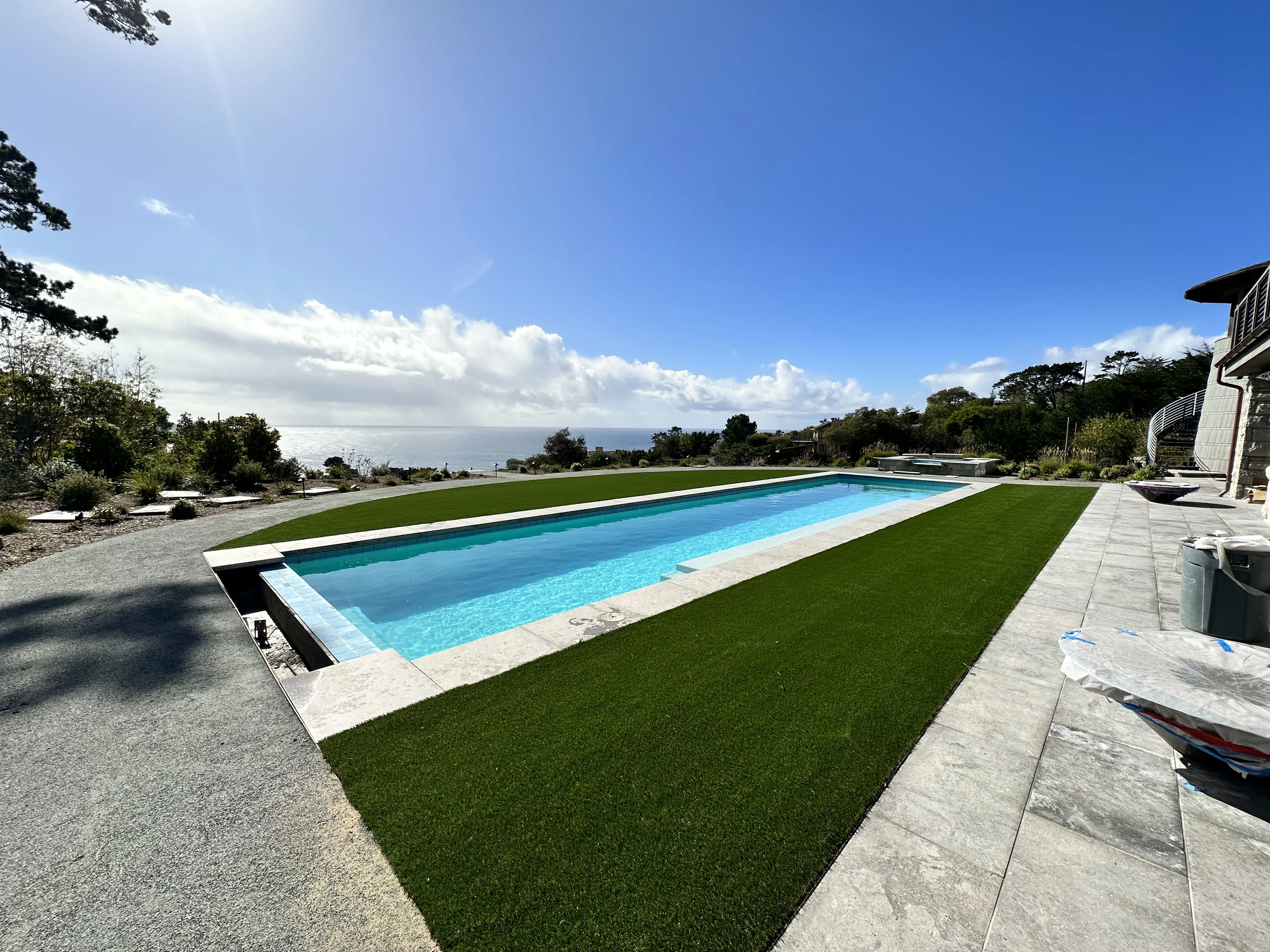
Infinity edge
Infinity Edge Pools, and When the Site Earns One
A vanishing edge is the most photographed feature in the industry and the most site-dependent. On the right lot it is extraordinary. On the wrong one it is an expensive weir you look at from above.
- CSLB #1079748 · C-53 Swimming Pool
- Based in Salinas, working the Monterey Bay
- Monday to Saturday, 8am to 5pm
The illusion needs somewhere to fall
An infinity edge works by hiding the far wall of the pool below your eye line, so the water appears to meet the horizon.
That only happens if there is ground falling away beyond the pool and a viewing position above the water — typically the house, a terrace or the shallow end. Build the same detail on flat ground and there is nothing for the edge to disappear into: you see the wall, the basin and the trick.
Which is why the honest answer on a lot without a fall is to spend the money on something else. Along this coast the sites that genuinely suit it are the ones you would expect — properties in Carmel Highlands and the Del Monte Forest looking over the ocean, hillside lots above Carmel Valley, ridge parcels in the Santa Cruz Mountains and the Aptos hills. On those, a vanishing edge is not an indulgence; it is the correct response to the view.
The second requirement is orientation. The edge has to be perpendicular to how you look at the pool, which means the view, the house and the pool have to agree with one another. Sorting that out is design work, and it happens before any of the engineering.
What is actually behind the edge
The visible part is a wall with water running over it. Everything that makes it work is out of sight.
The weir wall
The edge itself is a wall built dead level along its whole length. Tolerance here is measured in fractions of an inch, because water finds the low point and a wall that is out by a little will sheet unevenly and show it.
The catch basin
Water going over the edge falls into a hidden basin below. The basin has to be large enough to hold the water in transit plus the surge when several people get in at once, or it overflows and you lose water every time the pool is used.
A second pump
A dedicated pump lifts water from the basin back into the pool, continuously, whenever the edge is running. That is a second piece of equipment, a second electrical load and a second thing to service.
Auto-fill and level control
Vanishing-edge systems need their levels managed, because the basin and the pool are two connected bodies of water that both evaporate. Automatic level control is effectively mandatory rather than an upgrade.
Structure
A pool with a fall behind it is a retaining structure as well as a water container, and it is engineered as one. That is the real reason the detail costs what it does.
What it asks of you afterwards
Worth knowing before rather than after.
- It runs when you want it toThe edge only vanishes while the second pump is running. Many owners schedule it for the hours they are home rather than leaving it on continuously.
- WindA strong onshore breeze blows a thin sheet of water off the wall, which loses water and can stain what is below. Exposed coastal sites need this considered in the design.
- More surface, more evaporationA basin is additional exposed water, and on a windy site that adds up.
- The edge shows everythingScale and mineral deposits are more visible on a wetted wall than anywhere else in the pool, which makes balanced water more important, not less.
- Two bodies to serviceThe basin needs cleaning and its own attention. It is not self-maintaining.
Infinity edge questions
What is the difference between an infinity edge and a negative edge?
Nothing, in practice. Infinity edge, vanishing edge, negative edge and disappearing edge all describe the same detail: a wall the water flows over into a hidden catch basin. The variety of names is marketing rather than engineering.
Can I have an infinity edge on a flat lot?
Not in any way that produces the effect you are paying for. Without a fall beyond the pool there is nothing for the edge to disappear into. A perimeter-overflow detail is the flat-lot answer, and we will say so rather than sell you a wall.
Does it use a lot more water?
It exposes more surface — the wetted wall and the basin — which means more evaporation, and a windy site loses more still. A cover on the main pool offsets a good deal of that.
Is it noisy?
It makes continuous water noise, which is the point for most people. How much depends on the drop into the basin, and the drop is a design variable — a short fall into a well-detailed basin is a murmur, a long one is a waterfall.
Does it need more maintenance?
Somewhat. There is a second pump to service, a basin to keep clean, level control to keep working, and a wetted wall that shows deposits sooner than a submerged surface. None of it is onerous, and all of it is worth knowing in advance.
Free estimate
Tell us about the yard
Send a few photos and roughly what you have in mind, and we will tell you what is realistic on your site. Estimates are free and there is no obligation.