
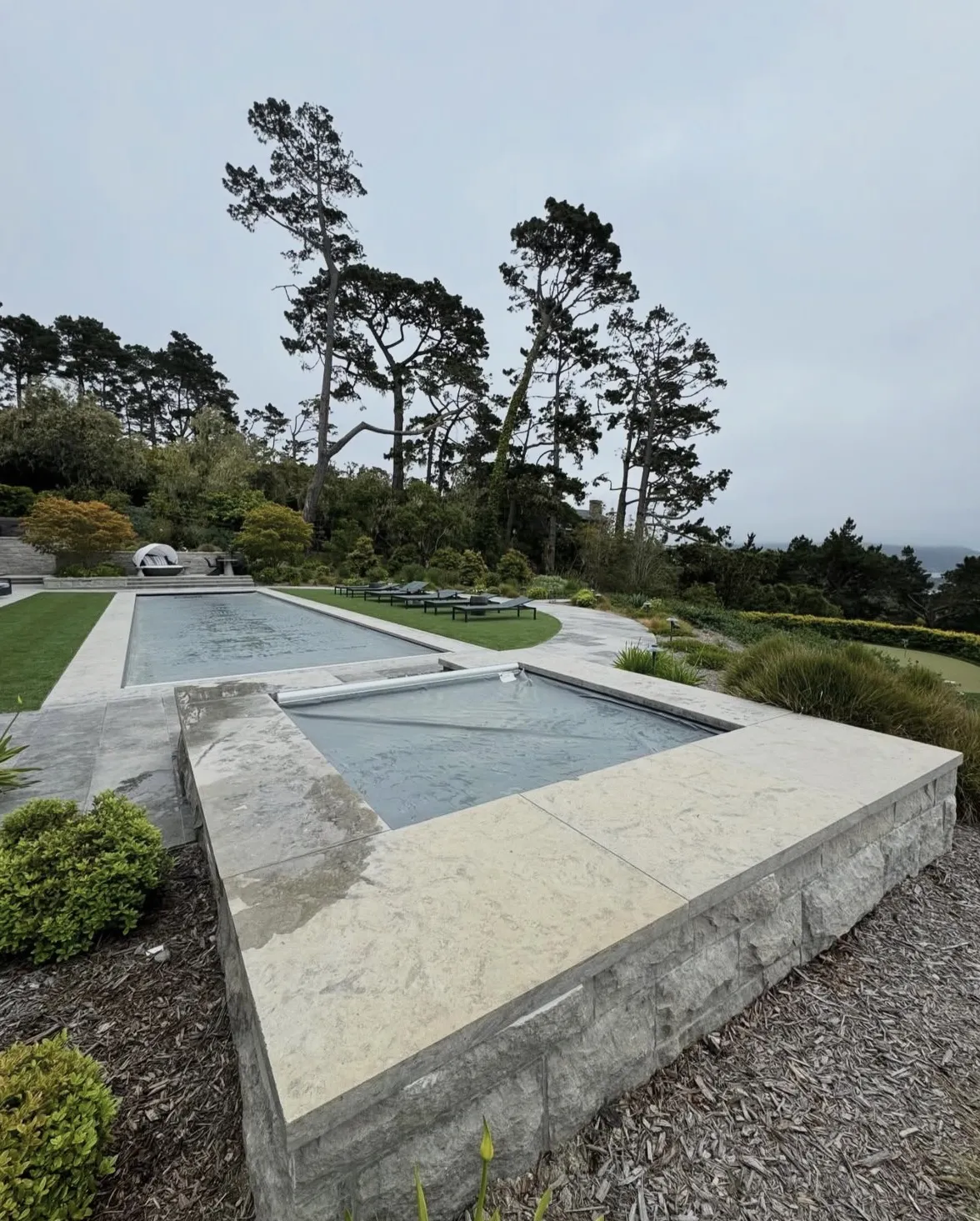
Covers & water
Pool Covers: The Highest-Return Item on a Pool
A cover does three separate jobs at once — safety, heat retention and water loss — which is why it is the only piece of pool equipment that pays back in three directions. In this region it is also, in most cases, required.
- Written by Supreme Pools · CSLB #1079748
- Regulatory claims linked to official sources
- Last checked September 12, 2026
How much water does a pool actually use?
Less than most people assume, and almost all of it in one go.
The fill is the big number: a pool takes its full volume once, at the start of its life, and again only if it is ever drained for resurfacing. After that, the ongoing consumption is evaporation plus whatever leaks. There is no continuous draw.
That makes a pool very different from the landscape it sits in. A lawn consumes water every week, indefinitely, for as long as it exists. A covered pool, past its fill, is a comparatively modest ongoing user — and a pool that replaced lawn can easily be the lower-water choice of the two.
Which puts the whole question on evaporation. Reduce that and you have reduced essentially all of a pool’s ongoing water use, and its heat loss at the same time, because they are the same physical process.
What a cover saves
Valley Water — the water district covering Santa Clara County, over the hill from us — states that using a pool cover can prevent up to 95 per cent of pool water evaporation. That is the headline number, and it is the reason every water agency in California that discusses pools recommends one.
The heat follows the same path. Evaporation is a phase change and phase changes carry a great deal of energy, so the surface you cover is the heat you keep. On this coast, where the afternoon breeze drives evaporation hard, that is not a marginal saving — it is the largest single lever on a heating bill.
And then there is debris. A covered pool collects far less of what falls out of the trees, which means less filter loading, lower sanitiser demand and less time with a net. Under the Monterey pines that is a genuine weekly difference.
It is also required
California’s Energy Code requires a pool cover on an outdoor pool or spa fitted with a gas heater or a heat pump, and it makes furnishing that cover the pool contractor’s responsibility. Gilroy’s own swimming pool submittal guidelines state it plainly and cite the code section.
Separately, an approved safety cover is one of the seven drowning-prevention features listed in California’s Swimming Pool Safety Act, of which a permitted pool needs at least two. So a cover can do double duty: satisfy the energy requirement and count towards the safety requirement at the same time — which is worth knowing when you are working out how to meet the safety obligation without a fence line cutting the yard in half.
Note that not every cover is a safety cover. The requirement is specific about the standard, so a floating solar blanket does not do that job even though it is excellent at the evaporation one.
The three kinds of cover
They do overlapping but not identical jobs, and only one of them is a safety device.
| Type | What it does well | What it does not do |
|---|---|---|
| Automatic safety cover | Covers the pool at the turn of a key, so it actually gets used. Retains heat, stops evaporation, keeps debris out, and can count towards the state safety requirement. | Costs the most; needs a rectangle or a simple geometry; the track and mechanism need periodic service. |
| Manual safety cover | Meets the safety standard at far lower cost. Good for closing a pool for a season. | Takes effort every time, so in practice it stays off. A cover that is not on is doing nothing. |
| Solar blanket | Cheapest by a distance, excellent at evaporation and heat retention, and adds a little solar gain. | Not a safety device. Awkward to handle, has a limited life, and needs somewhere to live when it is off. |
Water rules come from your supplier, not from the state
One thing worth being clear about, because there is a lot of confused writing on it: there is no single rule across our service area about filling a pool. Valley Water states the position plainly — restrictions on pools, including refilling, new construction and pool covers, are set by individual water retailers and cities and vary across the county.
That is equally true around the bay. The supply picture differs sharply between the Monterey Peninsula, the Salinas Valley — where the groundwater subbasin is designated critically overdrafted by the state — the Pajaro Valley, and inland San Benito and south Santa Clara counties. Each is managed differently and each retailer sets its own rules.
So the practical step before you plan a pool is a short conversation with whoever bills you for water, asking what currently applies to your address. We will help you frame the question. And the answer does not change the recommendation: fit a cover.
The rest of the water checklist
- Find leaks earlyAfter evaporation, leaks are the only other way water leaves. A bucket test separates the two in a couple of days and costs nothing.
- Do not oversize the poolThe fill is the largest single use. A pool sized for how you will actually use it is the first conservation decision.
- Cartridge filters do not backwashSand and DE filters discharge water every time they are backwashed. A cartridge filter is cleaned by hand and sends none down the drain.
- Keep the level at mid-skimmerToo high and the skimmer stops working; too low and the pump takes air. Neither wastes water directly, both waste energy.
- Windbreaks workWind drives evaporation. A hedge, a wall or siting the pool in the lee of the house reduces water and heat loss for free, permanently.
- Mind the water featuresMoving water in air evaporates faster than still water. Run features on a schedule rather than continuously and you keep the sound without the loss.
Cover and water questions
Is a pool cover required in California?
On an outdoor pool or spa with a gas heater or a heat pump, yes — the Energy Code requires one, and furnishing it is the pool contractor’s responsibility. Separately, an approved safety cover is one of the seven drowning-prevention features that can count towards the two required on a permitted pool.
How much water does a cover actually save?
Valley Water puts it at up to 95 per cent of evaporation. Since evaporation is essentially all of a pool’s ongoing water use once it has been filled, that is most of the ongoing consumption — and, because evaporation is also the dominant heat loss, most of the heating loss along with it.
Does a solar blanket count as a safety cover?
No. A floating solar blanket is very good at evaporation and heat retention and it is not a safety device. The safety requirement refers to covers meeting a specific standard, so if you want the cover to count towards the two required features, it has to be the right kind.
Is an automatic cover worth the extra?
On a coastal pool, usually yes, for one reason: it gets used. A cheaper cover that stays off the pool saves nothing. An automatic cover is a key turn, so it goes on nightly, and a cover that is actually on is where all the savings are.
Can I fill a pool during a drought?
It depends entirely on your water supplier and your city. There is no single rule across our service area — restrictions on filling, on new pools and on covers are set by individual retailers and vary. Ask your supplier what currently applies before you schedule a fill, and do it before you commit to a build date.
Does a pool use more water than a lawn?
Over time, generally not, provided it is covered. The pool takes its volume once and then loses only evaporation and leaks, while a lawn consumes water every week indefinitely. A covered pool replacing turf can be the lower-water outcome.
Where these facts come from
- City of Gilroy — Swimming Pool and Spa Submittal Guidelines (citing California Energy Code § 110.4(b)(2))Checked September 12, 2026
- Santa Clara Valley Water District — pool care tipsChecked September 12, 2026
- California Health and Safety Code § 115922Checked September 12, 2026
- California Energy Commission — 2025 Building Energy Efficiency StandardsChecked September 12, 2026
Free estimate
Tell us about the yard
Send a few photos and roughly what you have in mind, and we will tell you what is realistic on your site. Estimates are free and there is no obligation.