
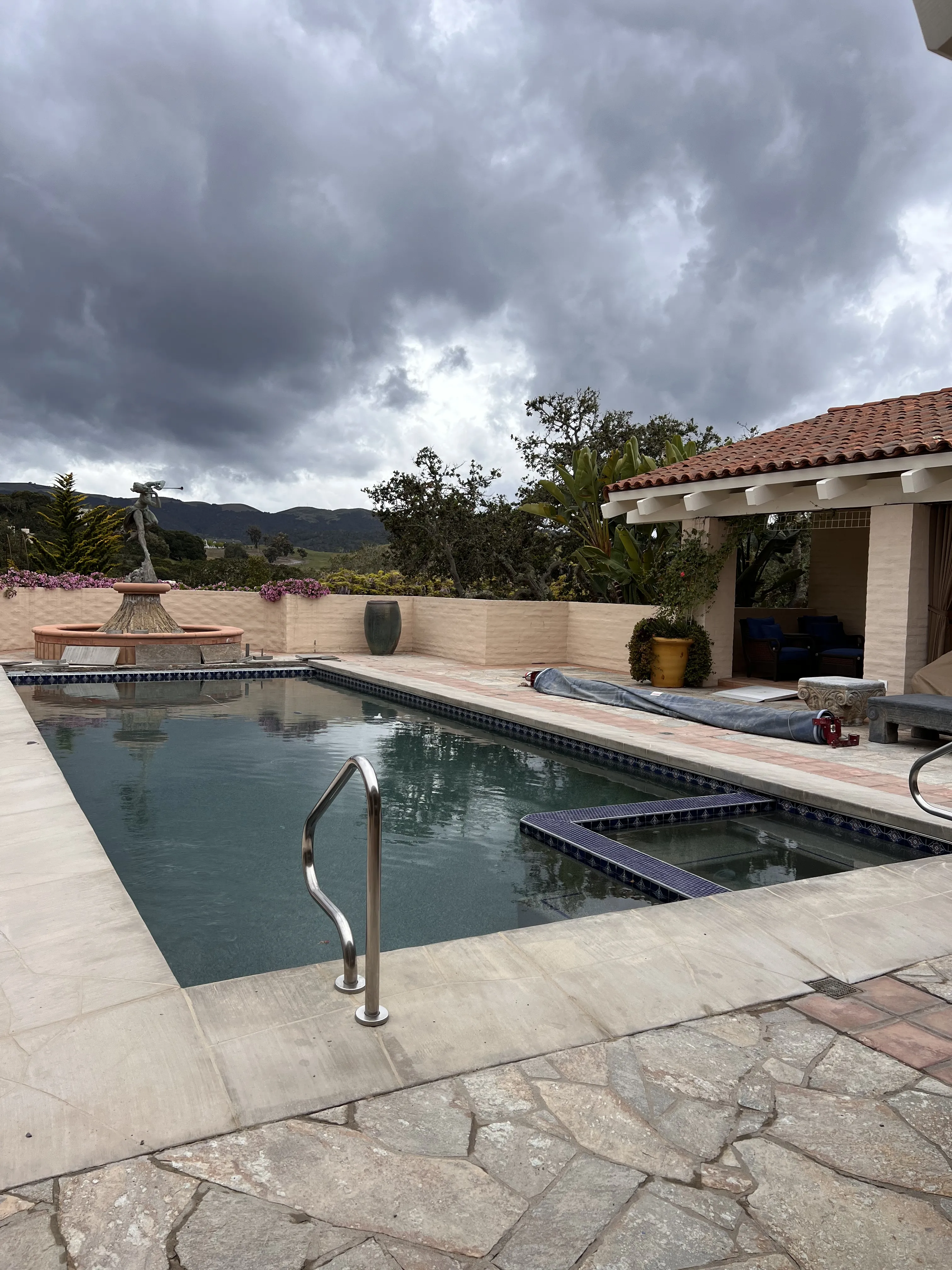
Heating
Heating a Pool on the Coast, Honestly
On the Monterey Peninsula and the Santa Cruz coast, heating is not an upgrade to a pool — it is the difference between a pool and an ornament. Here is where the heat goes and what actually stops it.
- Written by Supreme Pools · CSLB #1079748
- Regulatory claims linked to official sources
- Last checked September 12, 2026
Where the heat actually goes
Most people assume a pool loses heat to cold air. It mostly loses it to evaporation.
Evaporation is a phase change, and phase changes take a great deal of energy. Every molecule of water that leaves the surface as vapour carries heat away with it, and it does so far more effectively than the pool simply conducting warmth into cooler air. That is why the surface, not the volume, governs your heating bill.
And evaporation is driven by wind. Moving air strips the humid layer sitting directly above the water and replaces it with drier air, which lets more water evaporate, which takes more heat. A steady onshore breeze is therefore not a minor factor — it is the dominant one, and on this coast it arrives most afternoons.
Put those together and the Central Coast heating problem is specific rather than vague: cool air, high humidity gradients and reliable wind, on a surface you have deliberately made as large as possible. A pool in Monterey or Santa Cruz loses heat substantially faster than the identical pool in Hollister, Gilroy or the Salinas Valley, and no heater fixes the leak — it only compensates for it.
The cover is the actual answer
If evaporation is the leak, a cover is the lid. Covering the water stops the phase change, which stops the dominant heat loss, which is why a cover does more for a coastal pool than upgrading the heater does. Valley Water, over the hill in Santa Clara County, puts the reduction in evaporation at up to 95 per cent.
That number is about water, but the heat follows the same path. A covered pool holds temperature overnight rather than giving it back to the sky, which means the heater is topping up rather than starting from cold every morning. Over a season the difference is not marginal.
It is also required. California’s Energy Code requires a pool cover on an outdoor pool or spa with a gas heater or a heat pump, and makes furnishing it the pool contractor’s responsibility. So the question is not whether to have one — it is whether you get an automatic cover you will actually use, or a manual one that lives rolled up beside the shed.
Automatic covers cost considerably more and get used, which makes them the better buy on a coastal pool. They also satisfy a safety requirement, retain heat and keep debris out, which is three jobs from one item.
Heat sources, compared for this coast
| Gas heater | Heat pump | Solar | |
|---|---|---|---|
| Speed | Fast — hours | Slow — days to shift a pool | Slow, and only when the sun is out |
| Running cost | Highest | Much lower | Lowest |
| Cool-air performance | Unaffected | Falls as air temperature drops | Falls with cloud and fog |
| Best for | Spas, and heating a pool for a weekend | Holding a temperature across a season | Extending the shoulder season cheaply |
| Coastal caveat | Costs most exactly where heat is lost fastest | Weakest in the cool air a coastal pool has | Fog reduces the resource you are harvesting |
| Install requirement | Gas supply sized for the load; no standing pilot permitted | Electrical capacity and airflow around the unit | Roof area, orientation and a route for the plumbing |
What we usually specify here
For a coastal pool that has to be usable on demand — you want to swim this weekend, the fog has been in all week — a gas heater plus an automatic cover is the combination that works. The cover does the retention, the gas heater does the recovery, and you are not paying to hold a large volume warm through days you are not using it.
For a pool that will be used continuously through a season and where running cost matters more than speed, a heat pump plus a cover is better, with the caveat that a heat pump gets weaker as the air cools, which on this coast is exactly when you want it. Sizing it generously matters more here than inland.
Solar is genuinely cheap to run and worth having where the roof area, orientation and plumbing route exist, but on the fog belt it is a supplement rather than a primary source. Treat it as a way to extend the shoulder months at near-zero cost, not as the thing that makes the pool usable in June.
And whichever you choose: site the pool where something breaks the afternoon wind, and specify the cover properly. Those two decisions will save more energy than the difference between any two heaters.
Heating questions
Can I have a pool on the coast without a heater?
You can, and you will use it for a narrow window and be disappointed the rest of the year. The marine layer caps air temperature and the afternoon breeze drives evaporation, so an unheated, uncovered pool here spends most of the year as a water feature.
Does a cover really make that much difference?
Yes, and it is the highest-return item on the pool. Evaporation is the dominant heat loss from an open pool and a cover stops it — Valley Water puts the reduction in evaporation at up to 95 per cent. It also keeps debris out and, in the right form, satisfies a safety requirement.
Gas or heat pump on the coast?
Gas plus a cover for a pool you want warm on demand; a generously sized heat pump plus a cover for a pool held at temperature through a season. The coastal complication is that heat pumps lose capacity as the air cools, which is precisely when a pool here needs heat.
Is solar worth it in the fog belt?
As a supplement, yes — it costs almost nothing to run and will extend your shoulder months. As the only heat source on the immediate coast, no. The resource it harvests is the thing the marine layer removes.
Does a darker interior finish help?
A little, and it is free if you were choosing a finish anyway. A darker surface absorbs more solar gain, which on a fog-belt property is a small genuine benefit. It also shows deposits sooner and makes the bottom harder to see, so it is a trade rather than a free win.
Where these facts come from
- City of Gilroy — Swimming Pool and Spa Submittal Guidelines (citing California Energy Code § 110.4(b)(2))Checked September 12, 2026
- Santa Clara Valley Water District — pool care tipsChecked September 12, 2026
- California Energy Commission — 2025 Building Energy Efficiency StandardsChecked September 12, 2026
Free estimate
Tell us about the yard
Send a few photos and roughly what you have in mind, and we will tell you what is realistic on your site. Estimates are free and there is no obligation.