
Planning
What to Settle Before You Build a Pool
The homeowners who end up happiest with their pool are not the ones who spent the most. They are the ones who answered a short list of questions honestly before anyone drew anything.
- Written by Supreme Pools · CSLB #1079748
- Regulatory claims linked to official sources
- Last checked September 12, 2026
Start with how you will actually use it
Not how you imagine using it. How you will use it, given your life as it currently is.
Lap swimming, small children, entertaining and quiet soaking produce four genuinely different pools, and a pool that tries to be all four does none of them well. The useful exercise is to rank them rather than list them. If lap swimming is genuinely first, that fixes the length and everything else works around it. If it is fourth, do not buy a pool shaped by it.
Be honest about the children question in particular. A pool built around a five-year-old is a different pool from one built around a fifteen-year-old, and the five-year-old becomes the fifteen-year-old faster than the pool wears out. A shallow shelf and a gentle entry serve both. A four-foot-deep play pool serves only one.
And be honest about entertaining. If the real use is six adults around a table with the pool as the backdrop, then deck, shade, lighting and sound matter more than the water does, and the budget should reflect that.
The questions worth answering first
- What is the pool for? Rank swimming, children, entertaining and soaking. Do not tie.
- Where will you sit? Find the spot in the yard that has afternoon sun and shelter from the wind. That is where the deck goes, and the pool arranges itself around it.
- What will you look at? From the kitchen window, from the sofa, from the table. The pool is seen far more than it is swum in.
- How does a machine get in? Walk the access route. Measure the narrowest gate. This is the largest unknown in most estimates.
- What is already in the ground? Sewer lateral, gas, water, septic, leach field, irrigation, an old slab. Find out before you site anything.
- What are you prepared to maintain? Every feature has an upkeep consequence. Decide what you will actually look after.
- What will it cost to run? Heating, electricity, chemicals and service. On this coast, heating is the big one and a cover is the answer.
- What does your jurisdiction require? Permits, design review, coastal, trees, geotechnical. This drives the schedule more than construction does.
- What is the safety plan? California requires two of seven listed drowning-prevention features on a permitted pool. A fence line changes the deck layout, so decide early.
- What is the real budget? Including decking, landscape repair, furniture and the first year of running costs — not just the pool.
The two mistakes that are hard to undo
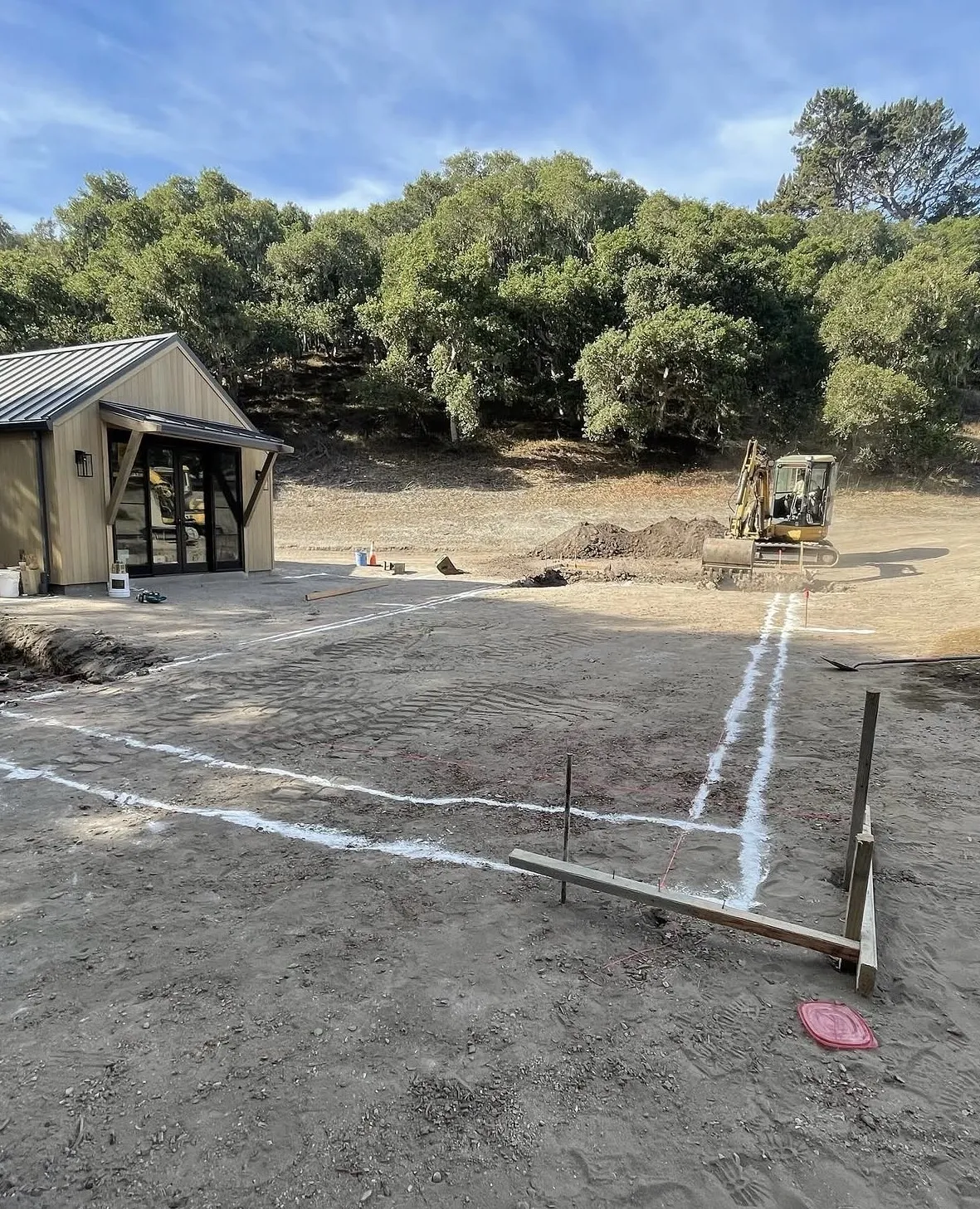
The first is siting. A pool in the wrong place in the yard cannot be moved, and the most common version of this is putting the pool where there is room rather than where the sun is. Mark the outline on the ground, leave it a week, and sit in the spot where the loungers would go at five in the afternoon. If it is in shade or in the wind, move the pool, not the loungers.
The second is under-specifying the invisible parts. Pipe size, the number of returns, the filter area, conduit for future lighting, a stubbed line for a water feature you have not committed to. All of it is cheap while the trench is open and expensive or impossible afterwards. If you are going to economise, economise on something you can change later.
Planning questions
How far in advance should I start?
Earlier than you think, because the approval path — not the construction — is what takes unpredictable time. If you want to swim next summer, having the design resolved and the permit application in well before spring is the difference between using the pool that year and the next.
Should I involve a landscape designer?
On a larger property it frequently produces the best result, because the pool is then part of a composition rather than an object. We build to designers’ drawings routinely and will flag anything that will not work hydraulically, structurally or under local code before it becomes a site problem.
Is it worth building in winter?
Winter construction is normal here, with a realistic allowance for rain during excavation and decking. The advantage is a pool that is ready when the weather turns rather than one you are waiting for through the summer.
What if I am not sure I want a spa?
Decide before shell day, because an attached spa is structural gunite and adding one later means cutting into a finished pool. If you are genuinely undecided, the cheap insurance is to have the plumbing and structure considered in the design even if you defer.
Where these facts come from
- California Health and Safety Code § 115922Checked September 12, 2026
- City of Gilroy — Swimming Pool and Spa Submittal Guidelines (citing California Energy Code § 110.4(b)(2))Checked September 12, 2026
Free estimate
Tell us about the yard
Send a few photos and roughly what you have in mind, and we will tell you what is realistic on your site. Estimates are free and there is no obligation.